Table of Contents
- Why Seek Samadhi Retreat Alternatives?
- Top Samadhi Retreat Alternatives: Quick Comparison
- 1. Harmony Hill Health Retreat (Tasmania)
- 2. Gwinganna Lifestyle Retreat (Gold Coast Hinterland)
- 3. Gaia Retreat & Spa (Byron Bay)
- 4. Billabong Retreat (Sydney)
- 5. Happy Buddha Retreats (Blue Mountains, NSW)
- 6. Kittawa Lodge (King Island, Tasmania)
Last Updated: July 26, 2026
Why Seek Samadhi Retreat Alternatives?
One-size-fits-all wellness programmes often fail high-pressure leaders, with executives returning from generic retreats slipping back into survival mode within weeks. A samadhi retreat alternative must deliver three things simultaneously: genuine detoxification, personalised attention, and practical tools that survive the return to real life.
According to research on executive wellness from the Harvard Business Review, leaders report sustained improvements only when retreat experiences address both mind and body in integrated ways. This guide covers retreat alternatives that achieve this balance, comparing what each offers, who they suit best, and what to realistically expect when you return home.
The most successful retreat outcomes happen when you choose based on your specific burnout profile, not just location or price. A retreat that works for stress-driven exhaustion may not work for decision fatigue or chronic inflammation. Know your primary challenge before booking.
Top Samadhi Retreat Alternatives: Quick Comparison
Australia’s wellness retreat landscape offers distinct approaches to healing. Understanding their core philosophies helps you identify which samadhi retreat alternative matches your needs.
| Retreat | Location | Best For | Key Focus |
|---|---|---|---|
| Harmony Hill Health Retreat | Tasmania | Executive burnout & thermal therapy | 6-day intensive with 2-3 guests |
| Gwinganna Lifestyle Retreat | Gold Coast Hinterland | Comprehensive wellness transformation | Multi-day retreats with organic cuisine |
| Gaia Retreat & Spa | Byron Bay | Luxury healing in rainforest | Customised schedules, award-winning spa |
| Billabong Retreat | Sydney (45 min) | Accessible wellness near major cities | Yoga, meditation, spa treatments |
| Happy Buddha Retreats | Blue Mountains, NSW | Silent meditation & stress management | Affordable 2-3 night silent retreats |
| Kittawa Lodge | King Island, Tasmania | Private coastal wellness escapes | Customisable yoga and meditation |
1. Harmony Hill Health Retreat (Tasmania)
Best for: Executive burnout and thermal therapy
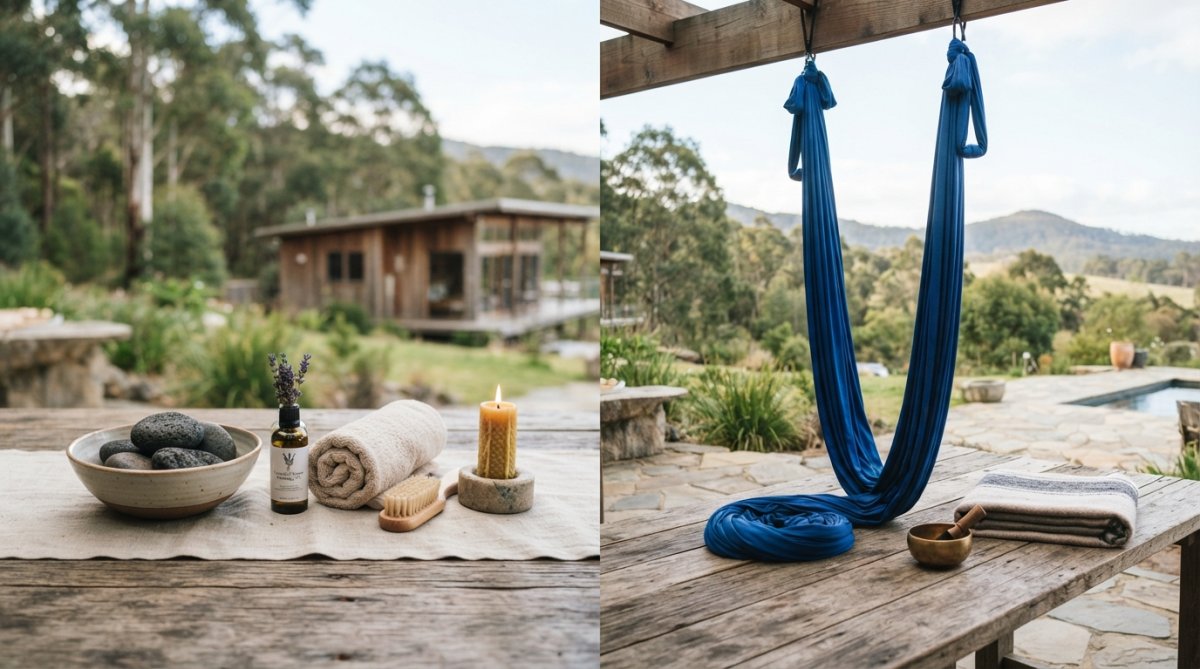
Harmony Hill Health Retreat stands apart as the most intensive samadhi retreat alternative for leaders battling severe burnout. This exclusive sanctuary welcomes only two to three guests per week, creating an environment where personalised attention becomes the healing mechanism itself. The 6-day Thermal Therapy Retreat programme combines ancient Egyptian teachings with modern detoxification protocols, specifically designed for executives stuck in high-pressure cycles.
The retreat’s core innovation is its focus on thermal therapy, using mineral-rich thermal experiences to trigger cellular detoxification and nervous system reset. Burnout is physiological, your nervous system has learned to stay in fight-or-flight mode. Thermal therapy addresses that directly at the cellular level, targeting the neural patterns that keep high-performers trapped in survival mode even when external pressure decreases.
The exclusivity creates both advantage and limitation. Two guests means facilitators understand your specific triggers and adjust the programme in real time. The limitation is availability, only two spots per week means booking requires planning months ahead. This retreat suits leaders who can commit to stepping fully away and have the flexibility to schedule six consecutive days.
Harmony Hill Health Retreat integrates thermal therapy with personalised programming, treating detoxification as a full-system reset that addresses both psychological patterns and physiological lock-in.
2. Gwinganna Lifestyle Retreat (Gold Coast Hinterland)
Best for: Comprehensive wellness transformation
Gwinganna represents a large-scale, multi-programme wellness operation that has earned recognition as Australia’s leading eco-certified health retreat. Where Harmony Hill emphasises exclusivity and depth, Gwinganna offers breadth and variety, making it an excellent samadhi retreat alternative for those seeking comprehensive transformation across multiple wellness dimensions.
The retreat operates fully inclusive programmes ranging from two to seven nights, with 100% certified organic wholefood cuisine and diverse healing spa treatments. Daily activities include qi gong, yoga, and guided nature hikes. Gwinganna’s strength lies in its specialised retreat tracks, stress management, nutrition optimisation, women’s health, sleep restoration, or mindfulness development. This modularity means you’re not paying for programming you don’t need.
You’ll be with 20-40 other guests, creating community but reducing one-on-one attention. The dining and activity schedule is set, though the Gold Coast Hinterland location offers natural beauty without requiring travel to Tasmania or remote coastal areas, making Gwinganna more accessible for those with limited time or mobility constraints.
3. Gaia Retreat & Spa (Byron Bay)
Best for: Luxury healing in rainforest sanctuary
Gaia Retreat & Spa is the award-winning luxury alternative for those prioritising both healing and aesthetic refinement. Nestled across 20 acres of Byron Bay rainforest, this retreat delivers transformative wellness experiences without sacrificing the comfort that makes rest actually possible. For leaders who find spartan retreat settings anxiety-inducing rather than restorative, Gaia’s approach to luxury as part of the healing process resonates deeply.
The retreat features luxurious rooms and villas immersed in rainforest, with a relaxing day spa offering personalised treatments. Morning yoga sessions and calming walking trails form the structure, but the schedule is customisable. The organic cuisine is thoughtfully prepared, and the overall experience prioritises restoration rather than intensive detoxification. The rainforest setting provides natural nervous system downregulation, and the spa treatments are central to the programme.
Byron Bay’s location makes it accessible from Sydney and Brisbane without requiring remote travel.
4. Billabong Retreat (Sydney)
Best for: Accessible wellness near major cities
Billabong Retreat is the samadhi retreat alternative for leaders who cannot justify extended time away but need genuine wellness intervention. Located 45 minutes from Sydney CBD, this eco-certified sanctuary offers yoga, meditation, mindfulness, and spa experiences without requiring a full week’s absence or travel to regional Australia.
The retreat operates day programmes starting from $125, making it accessible for those testing the waters before committing to longer stays. The facility includes a magnesium pool and far infrared sauna, both evidence-based tools for nervous system regulation, alongside traditional yoga and meditation classes. Billabong’s primary advantage is proximity and flexibility.
The limitation is that day retreats and short stays don’t provide the deep reset that longer immersions offer. You’re not achieving the cellular detoxification or nervous system recalibration that happens over five or six days. Billabong works best as either an introduction to retreat experiences or as regular maintenance for those who’ve already done deeper work elsewhere.
Day retreats and weekend stays provide temporary relief but rarely produce lasting change in burnout patterns. If your goal is genuine transformation rather than stress management, plan for at least 4-5 days at any retreat.
5. Happy Buddha Retreats (Blue Mountains, NSW)
Best for: Silent meditation and stress management
Happy Buddha Retreats offers the most affordable samadhi retreat alternative, with two-night silent meditation retreats starting at accessible price points. Located 90 minutes from Sydney in the Blue Mountains, the retreat specialises in guided meditation, mindfulness activities, and gentle yoga in a communal house setting.
The focus is pure meditation practice, silent introspection without the spa treatments, thermal therapies, or luxury amenities of larger retreats. The silent format removes the social performance that many high-performers find exhausting, even in retreat settings. Twin-share accommodation and communal living create a different energy than private villas.
Happy Buddha’s strength is accessibility, both financially and geographically. At under $900 for two nights, it’s a fraction of the cost of luxury retreats. The limitation is that silent meditation alone doesn’t address the physiological lock-in of burnout. This retreat works best for those whose burnout is primarily mental rather than systemic.
6. Kittawa Lodge (King Island, Tasmania)
Best for: Private coastal wellness escapes
Kittawa Lodge represents the ultra-luxury, fully customisable samadhi retreat alternative for those prioritising privacy and bespoke experience. Located on King Island, Tasmania, the retreat operates two fully-hosted eco-luxury villas with stunning coastal views, offering guests complete control over their wellness journey.
Unlike retreats with set schedules, Kittawa invites you to define your own retreat experience. Customised guided yoga and meditation sessions are available, as is access to private yoga platforms and secluded coastal walks. The emphasis is on self-directed healing within a beautifully curated environment. The coastal location provides natural nervous system regulation, and the gourmet dining features local, fresh produce.
Kittawa’s primary advantage is the combination of luxury, privacy, and customisation. The limitation is cost and accessibility. King Island requires travel from the mainland, and the retreat’s premium positioning reflects the exclusivity and luxury.
Direct Alternatives and Comparisons
The choice between these samadhi retreat alternatives hinges on three primary factors: your specific burnout profile, your available time and budget, and your preference for structure versus autonomy.
If your burnout is severe and physiological, manifesting as chronic inflammation, sleep disruption, or complete nervous system dysregulation, Harmony Hill Health Retreat’s intensive thermal therapy approach offers the most direct intervention. The six-day duration allows genuine cellular reset, and the exclusivity ensures personalised attention to your specific patterns.
If you’re seeking comprehensive transformation across multiple wellness dimensions and can commit 4-7 days, Gwinganna’s multi-programme approach and specialised retreat tracks work well. The scale means you’re not isolated, but you’re also not receiving one-on-one attention.
If luxury and aesthetic beauty are non-negotiable for your nervous system to actually relax, Gaia’s rainforest setting and spa-centric approach deliver healing through environment and comfort. The customisable schedule provides flexibility without the pressure of set programming.
If you’re time-constrained or testing retreat experiences for the first time, Billabong’s proximity to Sydney and flexible day-retreat options provide accessible entry points. The limitation is depth; weekend stays don’t produce lasting change, but they do provide temporary relief and clarity about whether longer retreats suit you.
If your burnout is primarily mental and you’re drawn to meditation as a primary healing tool, Happy Buddha’s silent retreat format and affordable pricing make it the most accessible option.
If privacy and full customisation are paramount, Kittawa Lodge’s bespoke coastal experience offers autonomy and beauty. The limitation is cost and the fact that you’re designing your own programme without professional guidance.
The most important question isn’t which retreat is “best”, it’s which retreat matches your specific burnout profile and constraints. Matching retreat type to your actual needs determines whether you experience lasting change or temporary relief.
Budget-Friendly Alternatives
Cost is a legitimate constraint. Happy Buddha Retreats is the most affordable option, with two-night silent retreats under $900. This is roughly one-tenth the cost of luxury alternatives. For those whose primary need is mental quieting rather than physiological reset, this delivers measurable value.
Billabong Retreat’s day programmes starting at $125 allow you to experience retreat benefits without committing to accommodation or extended time. A series of day visits across several months costs less than a single week at a luxury retreat. This approach works for maintenance and gradual nervous system regulation rather than intensive reset.
Some leaders combine approaches: a day retreat or weekend at Billabong to test the experience, followed by a longer stay at a more intensive retreat once they’ve confirmed the value.
Scientific and Clinical Efficacy
Research from the American Psychological Association on stress reduction and retreat experiences indicates that multi-day immersive wellness experiences produce measurable improvements in cortisol levels, sleep quality, and self-reported stress when the retreat includes both meditation and physical activity. The mechanisms involve both nervous system downregulation and physiological reset.
Retreat efficacy depends on duration (longer retreats produce more lasting change), personalisation (tailored programming works better than generic schedules), and integration of multiple modalities (meditation plus movement plus dietary intervention produces better outcomes than any single approach).
The thermal therapy approach used at Harmony Hill Health Retreat is based on established physiological mechanisms, heat exposure triggers parasympathetic activation, increases human growth hormone, and supports cellular detoxification.
The limitation is that long-term outcomes depend heavily on what happens after you return home. A six-day retreat that resets your nervous system does nothing if you return to the same schedule, relationships, and work patterns that created the burnout initially.
Virtual vs. In-Person Alternatives
Virtual meditation programmes and online wellness coaching cannot substitute for in-person retreat experiences for genuine burnout intervention. Virtual options provide value for maintenance and skill-building, but they don’t provide the nervous system reset that comes from stepping away from your environment, disconnecting from digital devices, and immersing yourself in a different setting for multiple consecutive days.
Burnout is a physiological state, your nervous system has learned to stay in fight-or-flight mode, your sleep is disrupted, your inflammation markers are elevated. The in-person retreat advantage is environmental. You’re physically separated from the triggers that keep your nervous system activated. This environmental change is itself therapeutic.
Virtual options can complement in-person retreats. Some leaders do a retreat, then use online meditation apps or coaching to maintain the benefits.
Choosing a samadhi retreat alternative means understanding not just what each retreat offers, but what your specific burnout requires. Harmony Hill Health Retreat’s intensive thermal therapy approach and exclusive personalisation make it the most direct intervention for severe executive burnout, particularly when your nervous system needs physiological reset alongside psychological work. The six-day immersion, limited guest capacity, and bespoke programming create conditions for genuine transformation. For leaders ready to step fully away and commit to deep work, this delivers the most measurable and lasting change. Explore Harmony Hill Health Retreat’s specific thermal therapy protocols and personalised programming to understand whether this intensive approach matches your burnout profile and constraints.
Frequently Asked Questions
What are the best samadhi retreat alternatives in Australia?
Top alternatives include Gwinganna Lifestyle Retreat (Gold Coast), Gaia Retreat & Spa (Byron Bay), Harmony Hill Health Retreat (Tasmania), Billabong Retreat (Sydney), and Kittawa Lodge (King Island). Each offers unique wellness programs, meditation practices, and healing services. Gwinganna excels in comprehensive detox; Gaia specialises in luxury healing; Harmony Hill focuses on thermal therapy and exclusivity. Choose based on location, program focus, and whether you prefer group or private experiences.
Are there affordable meditation retreats in Victoria and nearby regions?
Yes. Happy Buddha Retreats in the Blue Mountains (NSW, 90 minutes from Sydney) offers silent meditation retreats from $649-$897 for two nights, making it significantly more accessible than luxury alternatives. Kailash Ashram in Victoria provides traditional meditation and yoga retreats focused on self-discovery and spiritual growth. These options deliver mindfulness and stress management benefits without the premium price point of exclusive luxury sanctuaries.
How do I know if a wellness retreat alternative will actually work for burnout?
Look for retreats offering personalised healing programs, stress management techniques, and extended stays (5-7 days minimum). Harmony Hill and Gwinganna both provide bespoke programs tailored to individual needs. Check for post-retreat support or integration coaching, many leaders struggle when returning to high-pressure work. Ask about their approach to brain de-escalation and cellular detox. Retreats focusing on nervous system healing and mindfulness practices show stronger outcomes for burnout recovery than purely spa-focused experiences.
What's the difference between luxury wellness retreats in Australia and budget alternatives?
Luxury retreats (Gaia, Gwinganna, Harmony Hill) typically offer exclusive settings, personalised care, organic cuisine, and advanced healing modalities like magnetic field therapy. Budget alternatives (Happy Buddha, Billabong day packages) emphasise group meditation, yoga, and basic spa treatments. Luxury retreats often limit guest numbers for intimacy; budget options accommodate more participants. Both deliver wellness benefits, your choice depends on whether you prioritise seclusion, customisation, and premium facilities versus affordability and community connection.
Can virtual or hybrid wellness programs replace in-person retreat experiences?
Virtual meditation and mindfulness apps offer convenience and affordability, but lack the immersive environment, nature connection, and professional guidance of in-person retreats. Hybrid models, combining online coaching with a short residential stay, can bridge this gap. For genuine rejuvenation and deep transformation, especially for burnout recovery, in-person retreats with mineral springs, spa facilities, and dedicated therapeutic support remain more effective. However, virtual options work well for maintaining practices between retreats or for those with travel constraints.
This article was written using GrandRanker