

Table of Contents
- Understanding the Stress Response: Why Disconnecting Matters
- Signs of Executive Burnout and When to Act
- Create a Transition Ritual to End Your Workday
- Set Professional Boundaries and Communicate Availability
- Master Digital Detox: Managing Notifications and Always-On Culture
- Benefits of Thermal Therapy for Stress Recovery
- Work-Life Balance Strategies for Leaders
- Making Your Disconnection Stick: From Retreat to Reality
Last Updated: August 17, 2026
Understanding the Stress Response: Why Disconnecting Matters
When you remain in constant work pressure, your nervous system stays locked in heightened alert. Your body releases cortisol, the stress hormone, which impairs sleep quality, weakens immune function, and erodes decision-making capacity. Leaders who never step away find themselves caught in diminishing returns: more hours produce fewer meaningful results.
The real barrier isn’t understanding stress is harmful, most high-pressure professionals know that. It’s psychological and environmental. Work culture rewards constant availability, making disconnection feel like weakness. Yet neurobiology tells a different story: your brain needs recovery periods to consolidate learning, regulate emotion, and restore decision-making capacity.
When you disconnect from work stress, you’re activating your parasympathetic nervous system, designed to restore and rebalance. This shift requires intentional ritual, clear boundaries, and often a deliberate change of environment.
True disconnection isn’t about forgetting work exists. It’s about creating a genuine pause that allows your nervous system to shift from survival mode to recovery mode.
Signs of Executive Burnout and When to Act
Burnout in leadership roles often looks different from general stress. You might perform well externally while experiencing internal depletion. Warning signs are subtle at first, then unmistakable.
Watch for persistent sleep disruption that doesn’t improve with a single night off. Notice whether you wake at 3 a.m. with work scenarios cycling through your mind. Chronic sleep loss is one of the most reliable indicators that your stress response is stuck in overdrive.
Emotional regulation becomes harder. Small frustrations trigger disproportionate reactions. You find yourself short with your team, impatient with routine tasks, or unusually cynical about work that once engaged you.
Physical symptoms emerge: frequent illness, persistent tension, digestive issues, or general heaviness. Your body signals that recovery is overdue.
The distinction between temporary stress and burnout matters. Temporary stress responds to a good night’s sleep or a weekend break. Burnout doesn’t. You can take a long weekend and return to the same exhaustion. This is when incremental recovery strategies aren’t sufficient. A more substantial intervention creating genuine mental and physical detachment becomes necessary.
If you’re experiencing persistent sleep disruption, emotional flatness, or recurrent illness despite taking time off, these are signs that your stress response needs more than a standard weekend. A [structured retreat designed](/intensive-mind-body-reset-programs-guide/) for deep recovery may interrupt the cycle.
Create a Transition Ritual to End Your Workday
Without a clear ritual, work bleeds into evening hours. Your mind remains engaged with unresolved problems. Your body stays tense. By the time you’re supposed to relax, you’re already wound up.
A transition ritual signals to your nervous system: work is finished. It’s a structured sequence creating psychological and physical separation.
The most effective rituals have three components: a clear end point, a physical action, and a mental reset.
The clear end point might be closing your laptop at a specific time or stepping away from your desk. Specificity matters. "I’ll stop working when I feel like it" doesn’t work because there’s always one more task. A fixed time creates a boundary.
The physical action breaks the work-mode state. This might be changing clothes, taking a short walk, or moving your body in a way that feels intentionally different from work.
The mental reset interrupts the cycle of work thoughts. Do something that occupies your attention fully: a brief meditation, listening to a specific song, or engaging in a hobby requiring focus.
Remote vs. office-specific rituals
Remote work requires a different ritual structure because the boundary between work and home is blurred. You don’t have a commute to decompress.
For remote workers, the transition ritual should include physical departure from your work area. Close your laptop, move to a different room, change your clothes. The key is that each step moves you physically away from your work environment.
Office-based workers have a natural transition in the commute, but many waste it by replaying work conversations or checking email. An effective ritual reclaims this time. Listen to music or a podcast unrelated to work.
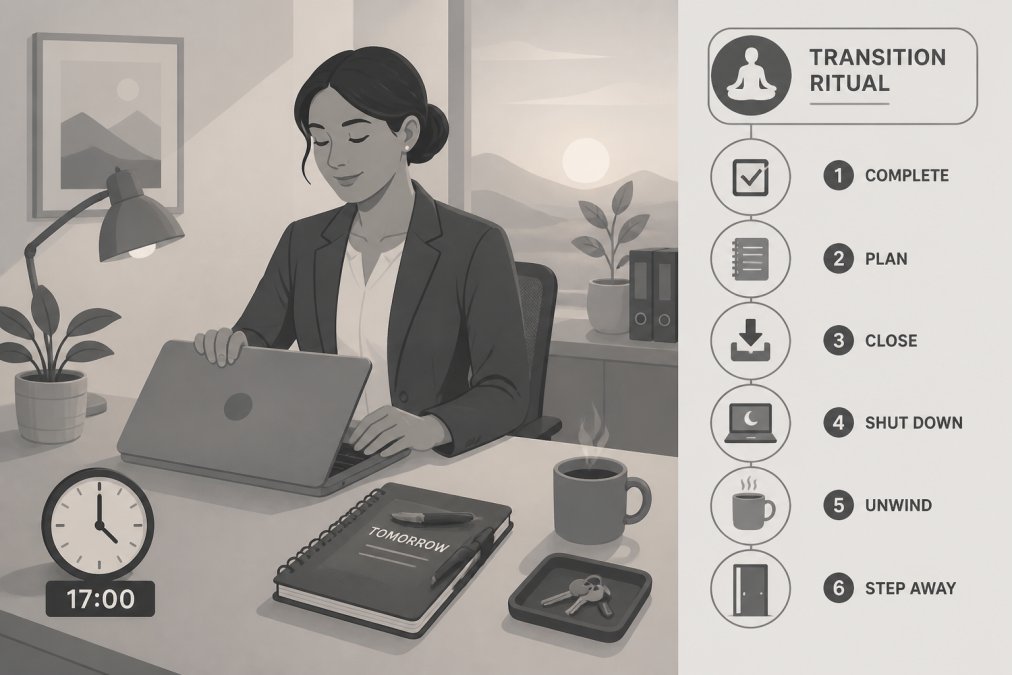
The ritual doesn’t need to be elaborate. It needs to be consistent. After two to three weeks of the same sequence, your nervous system recognizes it as a signal for recovery.
The most successful transition rituals for executives involve a physical location change or distinct sensory cue. If you work from home, stepping outside for five minutes creates a powerful boundary. The change in environment tells your brain that work mode is ending.
Set Professional Boundaries and Communicate Availability
Disconnecting from work stress is impossible if your team doesn’t know you’re unavailable. Boundaries only work when communicated clearly. Many leaders hesitate, fearing unavailability signals weakness. The opposite is true. Leaders who set clear boundaries and honour them model healthy behaviour and give permission to their teams to do the same.
Start by defining your actual availability. What hours are you working? When are you not available? Be specific. "I’m generally available until 6 p.m. weekdays" is clearer than "I try to keep evenings free."
Communicate this availability in multiple places: your email signature, your calendar, your team communication channels. Make it visible and consistent.
Set up automatic responses during offline hours: "I’m offline to focus on strategic work and personal recovery. I’ll respond to your message during business hours."
Define what constitutes an actual emergency for your role. True emergencies are rare. Most urgent-feeling requests aren’t actually emergencies. Having a clear definition prevents the scope of "emergency" from expanding infinitely.
When you disconnect from work stress by setting boundaries, you’re not abandoning your team. You’re creating conditions under which you can actually lead effectively. A rested, regulated leader makes better decisions than an exhausted one.
Master Digital Detox: Managing Notifications and Always-On Culture
The "always-on" workplace culture is one of the primary obstacles to genuine disconnection. Your phone buzzes with Slack messages, email notifications, calendar alerts. Each notification triggers a small spike in cortisol and pulls your attention back to work.
True disconnect from work stress requires managing your digital environment.
Start by disabling non-essential notifications entirely. Batch your communication checking into specific windows: perhaps 9 a.m., noon, and 3 p.m. Check everything at once, respond, then close the apps until the next window.
Remove work applications from your phone, or at minimum, disable their notifications. If you must have email on your phone, turn off notifications and set it to check only during work hours.
Establish a "no screens" period in the evening. Blue light suppresses melatonin production and keeps your nervous system stimulated. A minimum of 60 minutes before bed without screens improves sleep quality significantly.
The always-on culture is reinforced by the expectation that leaders respond immediately. You can shift this expectation by responding during business hours only. Your delayed response teaches your team that immediate response isn’t the norm.
Set a specific time to check and respond to messages, rather than responding as notifications arrive. This creates a psychological boundary: you’re not “always working,” you’re “working at specific times.”
Benefits of Thermal Therapy for Stress Recovery
Thermal therapy, exposure to heat in controlled settings, activates the parasympathetic nervous system directly. When your body is immersed in warm water or exposed to sauna heat, your blood vessels dilate, your heart rate decreases, and your muscles relax. This is a physiological shift toward recovery.
Heat therapy has been used across cultures for centuries, from Japanese onsen to Turkish hammams to Nordic saunas. Modern research validates what ancient practices discovered: thermal exposure reduces cortisol levels, improves sleep quality, and enhances cardiovascular function.
A 20-minute soak in a hot bath helps. An hour in a thermal bath in a peaceful environment, away from work obligations and digital distractions, creates a more substantial shift. The absence of work demands allows your mind to settle. The warmth allows your body to release tension.
For leaders experiencing chronic stress and burnout, thermal therapy in a dedicated retreat setting offers something a home bath cannot: genuine removal from the work environment. You’re not thinking about emails while soaking. You’re fully present with the physical experience of recovery.

The combination of thermal therapy with other recovery modalities, mindfulness, movement, nutrition, sleep in a distraction-free environment, creates a synergistic effect. Each element supports the others.
Work-Life Balance Strategies for Leaders
Work-life balance for high-pressure executives isn’t about equal hours in each domain. It’s about ensuring non-work time is genuinely restorative and work time doesn’t expand infinitely.
Define what balance means for you specifically. For some leaders, it means four evenings per week completely free of work. For others, one full weekend day with zero work contact. Specificity matters because vague intentions don’t create change.
Protect your recovery time with the same intensity you protect important meetings. Schedule it on your calendar. Treat it as non-negotiable.
Build hobbies and leisure activities that genuinely interest you, separate from work. These aren’t optional additions; they’re essential for mental health. Leisure activities requiring focus (learning an instrument, competitive sports, creative projects) are particularly effective because they occupy your attention fully.
Create accountability around your boundaries. Tell your partner, a close colleague, or a mentor about your disconnection goals.
Consider periodic intensive recovery. A weekend away isn’t enough for leaders in severe burnout. A structured retreat designed specifically for deep recovery and stress management, removing you from your normal environment for several days, creates a reset that shorter breaks cannot achieve.
A leader who works intensely for five days and genuinely recovers for two is more effective than one who works seven days at 60% capacity.
Making Your Disconnection Stick: From Retreat to Reality
The most common pattern after a retreat is initial improvement followed by a gradual slide back into old patterns. To make your disconnection stick, you need a structured re-entry plan.
In the final days of your retreat, reflect on what felt different. Which practices made the biggest difference? Which moments felt most restorative? Write these down specifically.
Identify which elements you can recreate in your normal environment. If thermal therapy was crucial, research accessible thermal facilities. If the absence of digital distraction was transformative, commit to specific offline times. If the structured daily rhythm was helpful, create a similar structure at home.
Before returning to work, communicate with your team about what’s changing. Let them know your new availability boundaries. When your team understands the changes and their importance, they’re more likely to respect them.
The first week back is critical. Honour your new boundaries strictly, even when pressure mounts. This teaches your team that the changes are real.
Build accountability into your week. Schedule a regular check-in with someone who knows your disconnection goals. When you know you’ll be reporting on this, you’re more likely to follow through.
Maintaining disconnection requires ongoing effort. Work culture pulls toward always-on. Your own habits pull toward overwork. This isn’t a problem to solve once; it’s a practice to maintain. The investment is worth it because the alternative, chronic stress, burnout, and declining performance, is far more costly.
The path to genuine disconnection from work stress begins with understanding that recovery isn’t optional, it’s foundational to sustainable performance. When you’ve experienced severe burnout or chronic fatigue, standard approaches often aren’t sufficient. A structured retreat designed specifically for deep nervous system reset and stress recovery can interrupt the cycle in ways that daily practices alone cannot achieve. At Harmony Hill Health Retreat, the focus is on creating the exact conditions that enable real transformation: removal from your normal environment, guided thermal therapy practices, and time for genuine psychological detachment. The goal isn’t to escape work forever, it’s to return to it genuinely restored, with the tools and boundaries to maintain that restoration over time.
Frequently Asked Questions
What are the signs I need to disconnect from work stress before burnout sets in?
Watch for persistent fatigue that sleep doesn't fix, increased irritability, difficulty concentrating, or sleep disruption. Physical signs include tension headaches and weakened immunity (catching every illness). Emotionally, you may feel detached from work or experience work-related anxiety outside office hours. If you're checking email at 11 PM or feel dread on Sunday evenings, these are clear signals your nervous system needs recovery. Early action prevents full burnout.
How do work-life balance strategies for leaders differ from standard advice?
Leaders face unique pressures: your team watches your behaviour, you're expected to be always available, and workload often expands to fill time. Effective strategies for leaders involve delegating authority (not just tasks), setting visible boundaries your team respects, and creating transition rituals that signal you're truly off-duty. Unlike individual contributors, your disconnection models healthy behaviour for your entire organisation, making it both personal recovery and cultural leadership.
Can I actually disconnect if my team will panic when I'm away?
Yes, with preparation. Brief your team before you disconnect: clarify who handles urgent matters, set clear response expectations (e.g., 'I'll reply to emails on Monday'), and establish an escalation protocol for genuine emergencies. Most team panic stems from unclear boundaries, not your absence. When leaders disconnect intentionally and return refreshed, teams actually perform better. Your recovery directly benefits your team's productivity and morale.
What makes thermal therapy effective for stress recovery compared to regular relaxation?
Thermal therapy works on multiple levels: heat reduces muscle tension, improves circulation, and triggers the parasympathetic nervous system (your body's relaxation response). Unlike passive relaxation, thermal immersion actively de-escalates your stress response at a cellular level. Combined with intentional disconnection from digital demands, thermal therapy accelerates mental fatigue recovery and supports emotional regulation, making it particularly effective for executives whose stress is both mental and physical.
This article was written using GrandRanker