
Table of Contents
- Understanding Thermal Therapy Benefits for Stress
- The Physiological Mechanism: Cortisol, Endorphins and Heat-Shock Proteins
- Sauna Benefits for Stress and Recovery
- Cold Plunge Benefits for Stress and Mental Resilience
- Contrast Therapy for Stress: Alternating Heat and Cold
- At-Home vs. Professional Thermal Therapy Modalities
- Stress Management Techniques Australia: Integrating Thermal Therapy Into Your Routine
- The Psychological Mechanism of Thermal Comfort and Emotional Regulation
Last Updated: July 30, 2026
Understanding thermal therapy benefits for stress requires insight into how controlled heat exposure activates your body’s natural stress-relief mechanisms. At Harmony Hill Health Retreat, we’ve observed that thermal therapy represents one of the most accessible yet underutilised pathways to nervous system regulation for high-pressure professionals. Heat therapy works by triggering physiological responses that lower cortisol, activate endorphin release, and facilitate deep cellular repair, all without pharmaceutical side effects.
According to research from the Journal of the American College of Cardiology, regular heat exposure correlates with measurable improvements in cardiovascular function and stress markers.
Understanding Thermal Therapy Benefits for Stress
Thermal therapy benefits for stress operate through multiple interconnected pathways: nervous system regulation, hormonal balance, blood circulation enhancement, and tissue-level repair. Consistency, duration, and how you structure your exposure matter more than the heat source itself.
How Heat Activates Your Nervous System
Your nervous system has two primary operating modes: sympathetic (fight-or-flight) and parasympathetic (rest-and-digest). Chronic stress locks most high-pressure professionals into sympathetic dominance. Heat therapy interrupts that pattern. When you enter a warm environment, your core temperature rises slightly. Your body responds by activating cooling mechanisms, vasodilation (blood vessel expansion), and sweating. This cooling response is fundamentally parasympathetic, you’re signalling safety to your nervous system through a physical mechanism.
The parasympathetic activation triggered by heat exposure creates the stress-relief effect. Your heart rate variability, the gap between heartbeats, improves, the marker of nervous system recovery.
The parasympathetic response to heat is strongest when you’re relaxed and not fighting the process. Breathing deeply and surrendering to the warmth amplifies the effect.
The Science Behind Thermal Stress Relief
Heat exposure triggers a well-documented physiological cascade. Your core temperature rises, activating heat-shock proteins, cellular repair mechanisms that reduce oxidative stress, stabilise proteins, and clear cellular debris. Simultaneously, your hypothalamus signals your pituitary gland to adjust hormone production. Cortisol begins to decline. Endorphins rise. Blood vessels dilate, improving circulation to tissues starved by chronic stress-induced vasoconstriction.
Most benefits require sustained exposure, typically 15-30 minutes of passive heat therapy per session.
The Physiological Mechanism: Cortisol, Endorphins and Heat-Shock Proteins
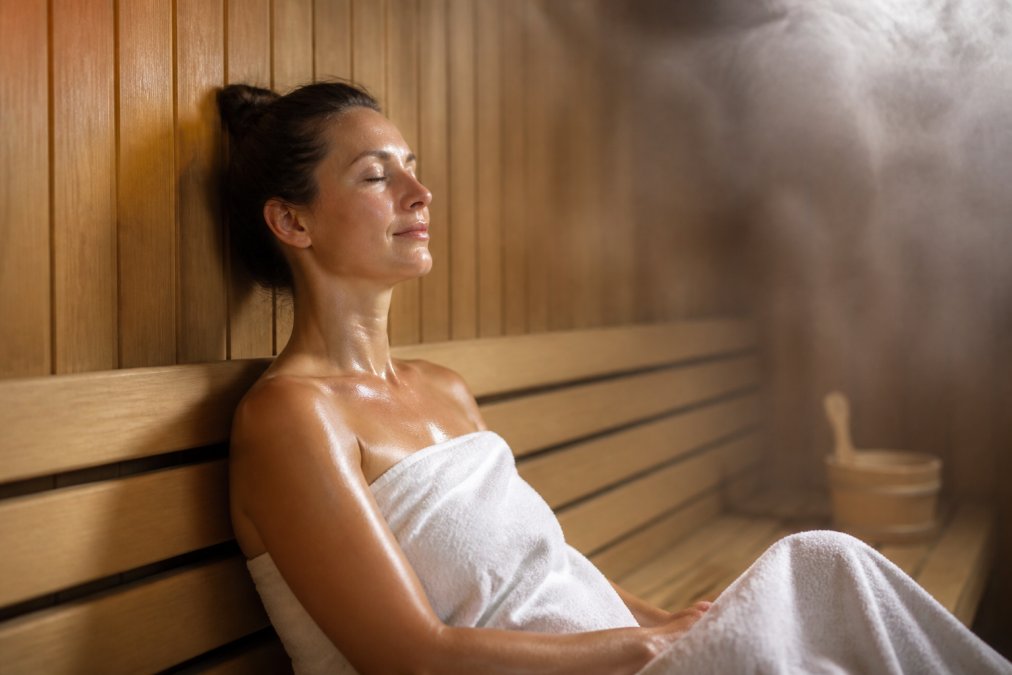
Three key mechanisms drive the stress-relief effect: cortisol suppression, endorphin activation, and heat-shock protein expression.
How Passive Heat Therapy Lowers Cortisol
Cortisol is your primary stress hormone. Chronic elevation becomes toxic, suppressing immune function, disrupting sleep, increasing inflammation, and accelerating cellular aging. Most executives in high-pressure roles have cortisol levels that remain elevated throughout the day and night.
Passive heat therapy creates a unique metabolic state. Your body isn’t in fight-or-flight. You’re not exerting yourself. Yet your physiology is activated. This combination signals your adrenal glands to downregulate cortisol production. The effect is measurable within 15-20 minutes and persists for hours after exposure.
Passive heat therapy is superior to active heat (like hot yoga or sauna exercise) for cortisol reduction because it activates parasympathetic recovery without the stress signal of physical exertion.
Endorphin Release and Parasympathetic Activation
Endorphins are your brain’s natural opioids. They reduce pain perception, elevate mood, and create wellbeing. Heat exposure triggers endorphin release through multiple pathways: the mild stress of heat activates your body’s natural pain-relief systems, and the parasympathetic activation that follows creates a neurochemical state associated with pleasure and contentment.
The endorphin elevation lasts 4-6 hours post-exposure. Consistent daily or twice-weekly heat therapy creates cumulative mood improvement. Parasympathetic activation is the foundation, when your vagus nerve is stimulated, it signals your entire nervous system to downregulate threat responses. Your breathing slows. Your digestion improves. Your immune function increases. Your sleep quality improves.
Sauna Benefits for Stress and Recovery
Sauna therapy is the most accessible modality for thermal therapy benefits for stress. A traditional sauna heats the air to 70-100°C. Your body responds by sweating, which facilitates detoxification, your sweat carries heavy metals, metabolic waste, and inflammatory compounds out of your body. The cardiovascular demand is significant: your heart rate increases, blood vessels dilate, and blood flow to your skin increases by up to 50%.
Most people experience sauna benefits within 3-4 sessions. Consistency is more important than intensity. A 20-minute session twice per week delivers better results than occasional long sessions.
Sauna use carries contraindications for certain populations. Those with uncontrolled hypertension, acute heart disease, or pregnancy should consult a healthcare provider before sauna use. Dehydration is a real risk, drink water before, during, and after sauna sessions.
Infrared vs. Traditional Sauna for Stress Relief
Traditional saunas heat the air; infrared saunas emit infrared radiation that penetrates your skin and heats your body from within. For stress relief specifically, infrared saunas have an advantage. Because they heat your body directly, you reach therapeutic core temperature faster (10-15 minutes versus 15-20 minutes) and tolerate longer sessions more comfortably. For pure stress reduction, both work, choose based on what your body tolerates best.
Cold Plunge Benefits for Stress and Mental Resilience
Cold exposure, immersion in water below 15°C for 1-3 minutes, seems counterintuitive for stress relief. Yet the adaptation that follows is profound. Your body learns to regulate stress responses more effectively. Your nervous system becomes more resilient.
Cold plunges trigger a massive release of norepinephrine, a neurotransmitter that enhances focus, mood, and pain tolerance. The initial shock activates your sympathetic system. Within minutes, your parasympathetic system engages to balance the activation. This back-and-forth trains your nervous system to handle stress more gracefully.
Cold plunge benefits are cumulative. A single exposure has minimal effect. But 2-3 sessions per week over 4-6 weeks produces measurable improvements in stress resilience, mood stability, and sleep quality. Immersion in 10-15°C water for 2-3 minutes is the sweet spot.
Contrast Therapy for Stress: Alternating Heat and Cold
Contrast therapy, alternating between heat and cold, amplifies the benefits of both modalities. You spend 3-5 minutes in heat (sauna or hot tub), then 1-3 minutes in cold (cold plunge or cold shower), then repeat 3-5 times. The alternation creates a powerful training stimulus for your nervous system.
Heat causes vasodilation. Cold causes vasoconstriction. Alternating between them trains your blood vessels to respond more dynamically. Your nervous system learns to transition between parasympathetic and sympathetic states more fluidly. Over time, this improves your overall stress resilience and emotional regulation.
How Thermal Contrast Enhances Nervous System Regulation
The nervous system adaptation from contrast therapy is measurable. Your heart rate variability improves, the marker of parasympathetic tone and stress resilience. Your cortisol response to stressors becomes more proportionate. You recover faster from acute stress events. Your sleep quality typically improves within 2-3 weeks of consistent contrast therapy.
Contrast therapy requires you to tolerate discomfort and then experience relief. Repeated practice trains your mind to view stress as temporary and manageable.
The transition from heat to cold is the most important moment. Breathe deeply and accept the shock rather than fighting it. This surrender activates your parasympathetic system and maximises the nervous system training effect.
At-Home vs. Professional Thermal Therapy Modalities
You don’t need a luxury retreat to access thermal therapy benefits for stress. But the choice between at-home and professional modalities matters.
DIY Heat Therapy for Daily Stress Management
At-home options are accessible and cost-effective. A hot bath (38-40°C for 20 minutes) triggers parasympathetic activation and cortisol reduction comparable to sauna therapy. A home infrared sauna provides daily access. Even a hot shower (as hot as you can tolerate for 10-15 minutes) delivers measurable stress relief.
The advantage of at-home thermal therapy is consistency. You can build a daily routine without travel time or scheduling constraints. The limitation is intensity and purity of experience. At home, you’re likely to be distracted, checking your phone, thinking about work. Distractions reduce the effect by 30-50%.
When Professional Supervision Matters
Professional thermal therapy settings offer advantages that at-home modalities cannot match. The environment is designed for relaxation with no distractions or work demands. Your nervous system receives a clear signal that you are safe and can fully recover.
Professional settings often combine thermal therapy with other recovery modalities: massage, breathwork, meditation, nutritional support, and sleep optimisation. This integration amplifies results. A 6-day intensive retreat that combines daily thermal therapy with professional guidance, personalised nutrition, and supervised recovery protocols produces transformation that at-home practice alone cannot achieve.
Professional supervision ensures safety. Contraindications are identified. The intensity is calibrated to your individual physiology.
For professionals in chronic burnout, a professional intensive retreat like Harmony Hill Health Retreat’s 6-day Thermal Therapy Retreat creates a reset that at-home practice rarely matches. The exclusivity (only two to three guests per week) ensures individualised attention. Most participants report a fundamental shift in their capacity to handle stress, sustained weeks after returning to their normal environment.
Stress Management Techniques Australia: Integrating Thermal Therapy Into Your Routine
Building a sustainable thermal therapy practice requires integration into your weekly rhythm and alignment with your stress patterns.
Safe Practices and Contraindications for Stress-Induced Conditions
Thermal therapy is generally safe for most populations, but certain conditions warrant caution. Those with uncontrolled hypertension should avoid extreme heat until blood pressure is stabilised. Pregnant women should consult their GP before sauna use. Those with acute infections or fever should avoid heat therapy until recovered. People with severe anxiety disorders may find the initial heat sensation triggering; gradual exposure and professional support can help.
For stress-induced conditions specifically, the risk is overuse. Some professionals become addicted to the endorphin release and use it as avoidance rather than genuine recovery. True stress management requires addressing the source of stress, not just masking the symptoms.
Building a Sustainable Thermal Therapy Protocol
Start with baseline assessment. How stressed are you currently? What’s your sleep quality? How’s your emotional regulation? Establish a foundational practice: 20-30 minutes of heat therapy, 3-4 times per week. Track how you feel, sleep quality, mood, stress resilience, and energy levels. Most people see measurable improvement within 2-3 weeks.
After 4-6 weeks, consider adding contrast therapy 1-2 times per week. After 8-12 weeks of consistent practice, you’ll notice that acute stress events no longer derail you. Your baseline cortisol is lower. Your sleep is deeper. Your immunity is stronger.
The protocol should evolve with your life. During high-stress periods, increase frequency. During recovery phases, maintain baseline practice but reduce intensity.
The Psychological Mechanism of Thermal Comfort and Emotional Regulation
Thermal therapy benefits for stress operate not just through physiology but through psychology. The experience of warmth is fundamentally comforting. It triggers early childhood associations with safety, nourishment, and unconditional care.
When you’re in heat, you’re in a state of surrender. You cannot force relaxation. You can only allow your body to do what it’s designed to do. This surrender is psychologically healing for high-achievers accustomed to control and optimisation. It teaches your mind that safety can be passive, that wellbeing doesn’t require constant effort.
The emotional regulation that follows is profound. Chronic stress creates emotional rigidity. Heat therapy opens that range. You become capable of deeper rest, genuine contentment, authentic vulnerability. These emotional states are unavailable to someone locked in sympathetic dominance. Lasting change requires repeated practice and re-education of your nervous system and mind.
| Practice Type | Frequency | Duration | Best For | Key Benefit |
|---|---|---|---|---|
| Hot bath at home | Daily or 5x/week | 20 minutes | Daily stress management, accessibility | Immediate cortisol reduction |
| Traditional sauna | 2-3x per week | 20-30 minutes | Detoxification, cardiovascular health | Comprehensive nervous system reset |
| Infrared sauna | 3-4x per week | 20-25 minutes | Joint mobility, skin health, stress relief | Faster adaptation, longer tolerance |
| Cold plunge | 2-3x per week | 2-3 minutes | Nervous system resilience, mental clarity | Enhanced stress adaptability |
| Contrast therapy | 1-2x per week | 20-30 minutes total | Advanced nervous system training | Maximum nervous system adaptation |
| Professional retreat | Once or twice yearly | 6 days | Intensive reset, burnout recovery | Comprehensive transformation |
Thermal therapy benefits for stress are measurable, repeatable, and accessible to anyone willing to build consistent practice. The physiological mechanisms, cortisol suppression, endorphin release, nervous system regulation, are well-established. The psychological benefits, emotional opening, and stress resilience follow naturally from the physiology.
For professionals in chronic burnout, at-home thermal therapy provides daily stress management. For those seeking comprehensive reset and fundamental recalibration of how your nervous system responds to pressure, a professional intensive retreat delivers transformation that daily practice alone cannot match. Harmony Hill Health Retreat’s 6-day Thermal Therapy Retreat combines daily passive heat therapy with personalised nutrition, professional massage, breathwork, and guided recovery in a setting designed for complete nervous system restoration. The exclusivity ensures individualised attention. Most participants report sustained improvements in sleep, stress resilience, emotional regulation, and vitality weeks after returning to their normal environment. Book your thermal therapy reset with Harmony Hill Health Retreat and reclaim your capacity to thrive under pressure.
Frequently Asked Questions
How does thermal therapy reduce stress and cortisol levels?
Thermal therapy activates the parasympathetic nervous system, which signals the body to shift from a stress response into a relaxation state. Passive heat exposure triggers vasodilation (widening of blood vessels), improving blood circulation and reducing oxidative stress. This process helps lower cortisol levels while simultaneously triggering endorphin release, your body's natural mood elevators. Heat-shock proteins are also activated during thermal stress, which support cellular repair and emotional regulation. Regular thermal therapy sessions help recalibrate your nervous system to become less reactive to everyday workplace pressures.
What is contrast therapy for stress, and how does it differ from sauna use alone?
Contrast therapy alternates between hot and cold exposure, typically sauna or warm water followed by cold plunge or cool water immersion. This approach creates a powerful stimulus for nervous system regulation and recovery protocols. While sauna benefits for stress focus on parasympathetic activation through sustained warmth, contrast therapy amplifies the effect by training your body to adapt to thermal stress more efficiently. The alternation strengthens vagal tone and improves your body's ability to shift between activation and relaxation states. This makes it particularly valuable for high-pressure professionals who need to toggle between focused intensity and genuine recovery.
Are there any contraindications or safety concerns with thermal therapy for stress-related conditions?
Thermal therapy is generally safe, but certain conditions require caution or medical clearance. Avoid heat exposure if you have uncontrolled hypertension, active cardiovascular disease, or are pregnant without professional guidance. Those with chronic pain conditions or inflammatory disorders should consult their GP before starting, as heat can sometimes exacerbate symptoms initially. People taking medications affecting heat tolerance (e.g., beta-blockers) should seek supervised therapy. Always stay hydrated, limit initial sessions to 10-15 minutes, and listen to your body. Professional modalities at wellness retreats include medical screening to ensure thermal therapy aligns with your health profile.
How long do the stress-relief benefits of thermal therapy actually last after a session?
Immediate benefits, reduced muscle tension, improved blood circulation, and mental clarity, typically last 2-6 hours after a single session. However, consistent thermal therapy practice creates cumulative, longer-lasting changes. Regular passive heat exposure (2-3 times weekly) recalibrates your baseline cortisol levels and strengthens parasympathetic tone, meaning you become more resilient to stress overall. Research suggests that sustained thermal therapy protocols over 6 days (like intensive retreat experiences) can reset your nervous system's stress response for weeks or months, particularly when combined with other mind-body practices. The key is consistency: one-off sessions provide relief, but integrated thermal therapy into your routine creates lasting homeostasis.
This article was written using GrandRanker