
Last Updated: November 2, 2026
Quick Summary
To switch off after a stressful workday, close the mental loop on work with a consistent after-work routine: write tomorrow’s top three priorities, shut down your laptop, change clothes, move your body, then wind down screen-free. Learning how to switch off after a stressful workday is a skill you build with repeatable steps, not willpower.
- Set a hard stop time with a five-minute warning alarm and turn off work notifications.
- A 45-minute end-of-day ritual starts by writing tomorrow’s top three priorities.
- Breathe in for four counts, hold for four, out for six, repeated for two minutes.
- Match decompression to your day: 20 minutes after a quiet day, 60 or more after an emotional one.
- If a work thought returns more than three times in an evening, make the smallest possible decision.
Table of Contents
- Why Switching Off After a Stressful Workday Feels Impossible
- Step 1: Set Work-Life Boundaries That Actually Hold
- Step 2: Build an After-Work Routine to Reduce Stress
- Step 3: Use Relaxation Techniques for Work Stress
- Step 4: Learn How to Stop Thinking About Work After Hours
- How Long to Decompress After Work (and What to Do If It Isn’t Working)
- When Everyday Work Stress Needs More Than a Routine
- Book Your Stay: Reclaiming Rest at Harmony Hill Health Retreat
- Frequently Asked Questions
Why Switching Off After a Stressful Workday Feels Impossible
That is why willpower alone fails. Understanding the hidden cost of always being on shows why business leaders need a true reset.
The good news: switching off is a skill, not a personality trait, and it can be built with a few repeatable steps.
Below, we break down a practical routine you can start tonight, plus what to do when your brain refuses to cooperate.
Step 1: Set Work-Life Boundaries That Actually Hold
Boundaries only work when they are specific. “I’ll try to log off earlier” is a wish; “laptop closed by 6:30pm, phone in a drawer until 8pm” is a boundary. Write yours down and tell one person, public commitments hold far better than private ones.
Working Hours and Out-of-Hours Communication
Decide your finish line before the day starts. Then protect it.
- Set a hard stop time and a five-minute warning alarm
- Turn off work notifications on your phone at that stop time
- Create an auto-reply that sets expectations for after-hours emails
The last point matters most. Most “urgent” messages are not urgent. They are simply someone else working late.
Different Strategies for Remote, Hybrid and On-Site Workers
Your work setting changes the tactics, not the goal.
- Remote: Home and office share an address, so you need a physical signal. Shut the study door, pack the laptop away, or take a short walk at day’s end.
- Hybrid: Use the commute home as a deliberate buffer, no work calls in the car or on the train, just music, a podcast, or silence.
- On-site: The commute already separates you from work; the risk is carrying the day home in your head. Use the first ten minutes after arriving to change clothes and reset before discussing work.
Step 2: Build an After-Work Routine to Reduce Stress
Knowing how to switch off after a stressful workday starts with an after-work routine, which works because it gives your brain a predictable sequence that signals safety. The content matters less than the consistency. Done the same way each day, the routine itself becomes the off switch.
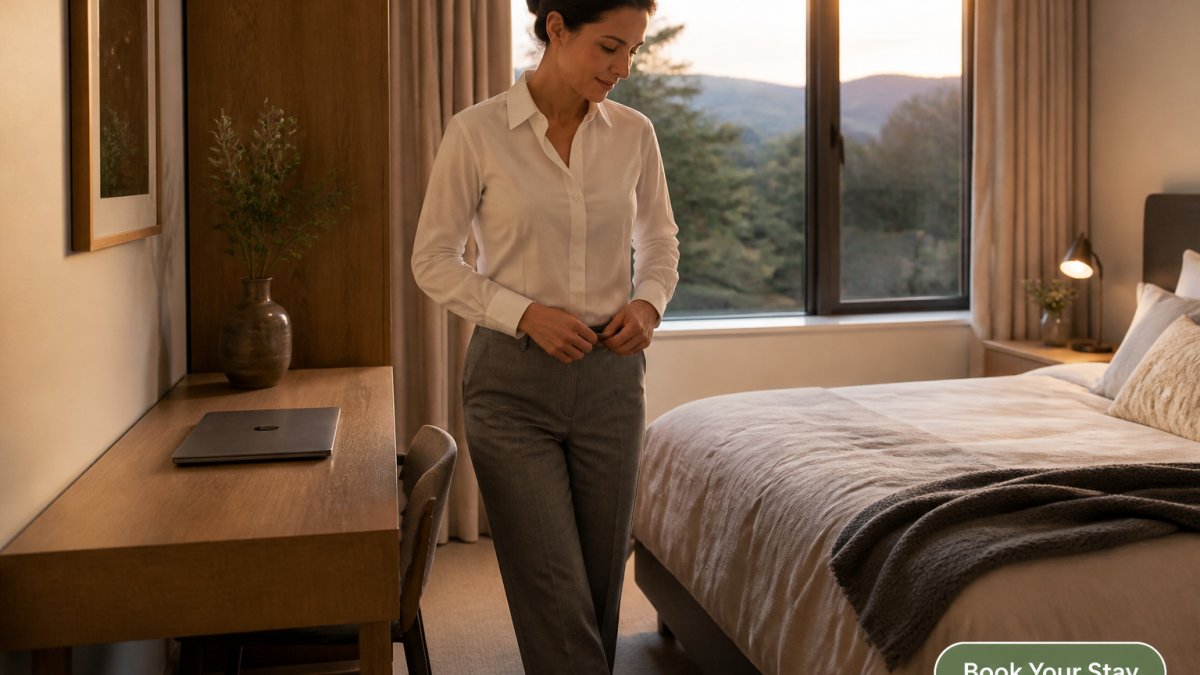
Changing out of work clothes can mark a clear shift into the evening, and grooming rituals for stress can make that transition feel more deliberate.
A Timed End-of-Day Ritual
Try this 45-minute sequence. Adjust the times, keep the order.
|
Time |
Action |
Why It Helps |
|---|---|---|
|
0-5 min |
Write tomorrow’s top three priorities |
Closes the mental loop |
|
5-10 min |
Shut down the laptop, clear the desk |
Physical end signal |
|
10-20 min |
Change clothes and shower |
Washes the day off |
|
20-35 min |
Walk or light exercise |
Burns off stress hormones |
|
35-45 min |
Herbal tea, no screens |
Cues the body to wind down |
What most guides miss is the first step. Writing down tomorrow’s priorities tells your brain the information is stored, so it stops rehearsing it. Skipping this and going straight to “relaxing” rarely works when your head is still full.
Step 3: Use Relaxation Techniques for Work Stress
Relaxation techniques for work stress calm the body first, which then quiets the mind. That order matters.
Start with slow breathing: in for four counts, hold for four, out for six, repeated for two minutes. The longer exhale is the active ingredient, because it triggers the body’s rest response.
Other options that work well after a hard day:
- Ten minutes of gentle yoga or stretching
- A guided body scan before bed
- Progressive muscle relaxation, tensing and releasing each muscle group
Pick one and do it daily for a week. If you want a wider menu of methods, our guide on effective ways to reduce stress covers more options you can rotate through.
Step 4: Learn How to Stop Thinking About Work After Hours
Knowing how to stop thinking about work after hours comes down to one rule: do not fight the thought, redirect it. Suppressing a thought makes it louder; giving it a small, contained outlet makes it quieter. Redirection only works if you also address the two things that keep work thoughts returning: unfinished tasks and genuine after-hours obligations.
A Four-Step Response When a Work Thought Arrives
- Capture it. Write it on a notepad labelled “tomorrow,” then close it. Writing tells your brain the information is stored, so it stops rehearsing it.
- Name it. Say silently, “That’s a work thought, not an emergency.” Naming moves the thought from feeling to observation, which reduces its grip.
- Redirect your senses. Splash cold water on your face, step outside, or focus on five things you can see. Sensory redirection interrupts the loop at the body level faster than mental redirection.
- Schedule worry time. Give yourself fifteen minutes earlier in the evening to think through work problems; outside that window, defer. A scheduled window can help reduce intrusive thoughts over time.
If the same thought keeps returning, it usually points to something unfinished. One quick note about the next action often settles it. For a deeper approach to quieting a busy mind, see our guide on how to disconnect from work stress.
When Work Thoughts Keep Returning: Handling Unfinished Tasks and Tomorrow’s Anxiety
Rumination after hours is rarely random. It clusters around three triggers: a task you did not finish, a conversation you are dreading, or uncertainty about what tomorrow holds. Each has a different response.
- Unfinished task: Write the single next action, not the whole project. “Draft the opening paragraph” is actionable; “finish the report” is not. A specific next step gives your brain a closed loop.
- Dreaded conversation: Write the first sentence you will say. Rehearsing the opening line is enough to reduce anticipatory anxiety; rehearsing the whole conversation tends to increase it.
- Uncertainty about tomorrow: List what you know and what you will find out. Separating the two stops the mind from treating unknowns as threats.
If a thought returns more than three times in an evening, treat it as a signal rather than a nuisance: the task needs a decision, not more thinking. Make the smallest possible decision, even “I will ask for an extension tomorrow”, and write it down.
When You Cannot Avoid After-Hours Work
Some roles genuinely require out-of-hours availability. Boundary advice that ignores this is unhelpful. The goal shifts from avoiding after-hours work to containing it so it does not swallow the whole evening.
- Set a response window, not a response ban. “I check messages at 8pm and 9:30pm for fifteen minutes” is more sustainable than “I never check.”
- Use a script for urgent requests. “I can pick this up at 8pm for fifteen minutes, is that soon enough, or does it need someone now?” signals availability without committing your whole evening.
- Escalate genuine emergencies once, in writing. If after-hours requests are routine rather than exceptional, raise it with your manager as a workload issue, not a personal boundary failure.
Watch out: if after-hours work becomes the norm rather than the exception, a nightly routine will not fix it. That is a workload and workplace-expectations issue worth raising directly rather than absorbing indefinitely.
How Long to Decompress After Work (and What to Do If It Isn’t Working)
How long it takes to decompress after a demanding day depends on the intensity of the day rather than willpower, a high-stakes day with back-to-back decisions generally takes longer than a quiet one. Rather than prescribing one routine for everyone, match the length and type of decompression to the day you actually had.
Match the Decompression to the Day
|
Type of day |
Typical decompression time |
Best first move |
|---|---|---|
|
Quiet, low-stakes day |
20 minutes |
Change clothes, short walk |
|
Busy but predictable |
30-40 minutes |
Movement, then a screen-free wind-down |
|
High-stakes, decision-heavy |
45-60 minutes |
Physical exertion first, quiet second |
|
Emotionally draining (conflict, bad news) |
60 minutes or more |
Social connection or solitude, depending on preference |
A common pattern is trying to relax before discharging the day’s physical arousal. Movement first, quiet second, works better than the reverse for most people.
A Decision Guide: Choose the Strategy That Fits You
Not every tip suits every person. Use these questions to pick the right approach rather than trying all of them.
- Physically restless? Choose movement, a walk, a workout, or stretching. Restlessness rarely responds to sitting still.
- Flat or numb? Choose sensory input, a shower, cold water, music, or cooking. Numbness responds to stimulation, not rest.
- Wound up and irritable? Choose slow breathing or a body scan. Irritability often signals an over-activated nervous system that needs down-regulation.
If you are unsure, start with movement. It is the most reliable first move because it addresses the physical side of stress, which then makes the mental side easier to settle.
If an Hour Passes and You Still Feel Wired
Check three things before assuming the routine has failed:
- Did you move your body? Physical activity is the fastest way to discharge stress hormones; without it, the body stays in alert mode regardless of what the mind does.
- Did you eat properly? Low blood sugar mimics anxiety, shakiness, irritability, a racing feeling. A proper meal or snack is often the missing step.
- Did you stay on screens? Scrolling keeps the brain in input mode and delays the shift into rest.
If none of those help and the pattern repeats night after night, that is worth noting. It may be a sign that rest alone will not fix it, and that the stress needs attention at a different level.
If you want a structured environment to reset, Explore Our Retreat and see how a longer break can help you rebuild a decompression routine that actually holds.
When Everyday Work Stress Needs More Than a Routine
Sometimes a routine is not enough, and that is not a failure. In Australia, Lifeline offers free crisis support on 13 11 14, and Beyond Blue provides mental health information and referral options.
For leaders whose stress has moved beyond a nightly routine, a longer reset can help. Our stress retreat guide explains what to look for. If the pressure has been building for a while, our 5-Night Stress Release Retreat is designed to help you step away and unwind.
Book Your Stay: Reclaiming Rest at Harmony Hill Health Retreat
The routines above will carry you through an ordinary hard day. But if you have been running on empty for months, a weekend of good sleep will not undo it.
At Harmony Hill Health Retreat, guests step away from the noise.
You can view our Tasmanian retreat and see what a stay looks like. When you are ready, Book Your Stay and give your nervous system the reset it has been asking for.
Frequently Asked Questions
How do I stop thinking about work after hours?
Give the thoughts somewhere to go. Write tomorrow’s priorities and any unfinished tasks on paper before you close your laptop, so your brain stops rehearsing them. Then replace the mental loop with something that occupies your hands and attention, such as cooking dinner, a walk, or a hobby. If a work thought still arrives, note it and return to what you were doing. Persistent rumination that disrupts sleep most nights is a signal to seek professional support.
What is the best way to unwind after a stressful day at work?
The best unwind is the one that creates a clear line between work and personal time. A short transition routine works well: change out of work clothes, step outside for fresh air, and do ten minutes of slow breathing or gentle movement before you sit down. Follow it with something you enjoy, like a cup of tea or dinner with no screens. Consistency matters more than the specific activity, because repetition teaches your body that the workday has ended.
How long does it take to decompress after work?
Most people need somewhere between 20 and 60 minutes of deliberate transition before work stress settles. The length depends on how demanding the day was and how activated you feel. A short walk or breathing practice can shift your state in 10 to 15 minutes, while a heavier day may need a longer routine. If you find you are still wound up hours later, or the tension follows you to bedtime, that is worth discussing with a health professional.
Can exercise help reduce stress after work?
Yes. Physical activity gives stress hormones somewhere to go and breaks the mental loop that keeps work thoughts circulating. You do not need a hard session: a brisk walk, a swim, or 20 minutes of yoga after work is enough to notice a difference. Try to move before dinner rather than late at night, since intense exercise close to bedtime can make it harder to fall asleep. Pair it with the rest of your after-work routine for the best effect.
If your version of switching off is a closed laptop and a quiet evening, start there tonight. If it is six days of deep rest with no one asking anything of you, we would be glad to host you. Explore Our Retreat at Harmony Hill Health Retreat and take the first real step out of survival mode.