

Table of Contents
- Understanding the Post-Retreat Integration Challenge
- Post-Retreat Integration Tips: Your First 48 Hours
- Creating a Home Wellness Sanctuary
- Mindfulness Practices for Daily Life
- Building Sustainable Daily Habits to Maintain Retreat Wellness
- Digital Detox Maintenance and Stress Management
- Revisiting Retreat-Learned Techniques Weekly
- Journaling for Self-Reflection and Progress
Last Updated: August 14, 2026
Understanding the Post-Retreat Integration Challenge
Returning from a wellness retreat is disorienting. Within 48 hours, old patterns reassert themselves. Within a week, you’re wondering if the retreat actually happened at all.
This isn’t failure. A retreat creates a "therapeutic window" where your nervous system downregulates and your mind settles. But that window closes the moment you re-enter your normal environment. Without a deliberate integration plan, the shift back to high-pressure living happens automatically.
The research is clear: lasting transformation requires a structured transition plan, not just good intentions. Harmony Hill Health Retreat recognises this gap. Their 6-day Thermal Therapy Retreat is designed with integration in mind, but the real work happens at home. This guide walks you through a practical 6-week framework to maintain retreat wellness and build habits that stick.
Post-Retreat Integration Tips: Your First 48 Hours
Managing the ‘re-entry’ shock
The first 48 hours are critical. Your nervous system is still downregulated; your environment is not. This collision is what most people experience as the "retreat high" wearing off. It’s not that the retreat failed, your brain is simply re-escalating in response to environmental change.
Expect the re-entry shock and don’t interpret it as evidence of failure. Your goal is to slow that re-escalation, not prevent it entirely.
For your first 48 hours:
Delay your return to work. Take an extra day at home if possible, or at least block your calendar to avoid back-to-back meetings on your first day.
Don’t check email immediately. Set a specific time, say 4 PM on your first day, to begin processing messages.
Protect your sleep. Avoid screens for two hours before bed. Keep your bedroom cool and dark. Use breathing techniques to settle your nervous system.
Do one grounding activity in the first 24 hours. A 10-minute walk, meditation, or journaling anchors you to the present moment rather than waiting stress.
Setting boundaries with work and technology
Your workplace expects immediate resumption of normal operations. You need to actively push back.
Communicate your availability before you return. Send an email 24 hours before you’re back: "I’m returning tomorrow. I’ll be checking email from 10 AM to 4 PM only. For urgent matters, contact [colleague name]."
Establish screen-free windows. Replicate the retreat’s device-free periods at home, even if just 90 minutes in the evening.
Block focus time on your calendar. Schedule two 90-minute blocks per day where you’re unavailable for meetings. Use this time for deep work that requires the mental clarity you’ve reclaimed.
Say no to new commitments for two weeks. You’re in integration mode. New commitments will disrupt the habits you’re building.
Creating a Home Wellness Sanctuary
Designing your physical space
A retreat works partly because the environment supports wellness. You can create a corner of your home that does the same.
You need:
- A comfortable place to sit (a cushion, chair, or yoga mat)
- Soft, warm lighting (a lamp or natural window light)
- Minimal visual clutter (clear of work materials and stress triggers)
- A small plant or natural element
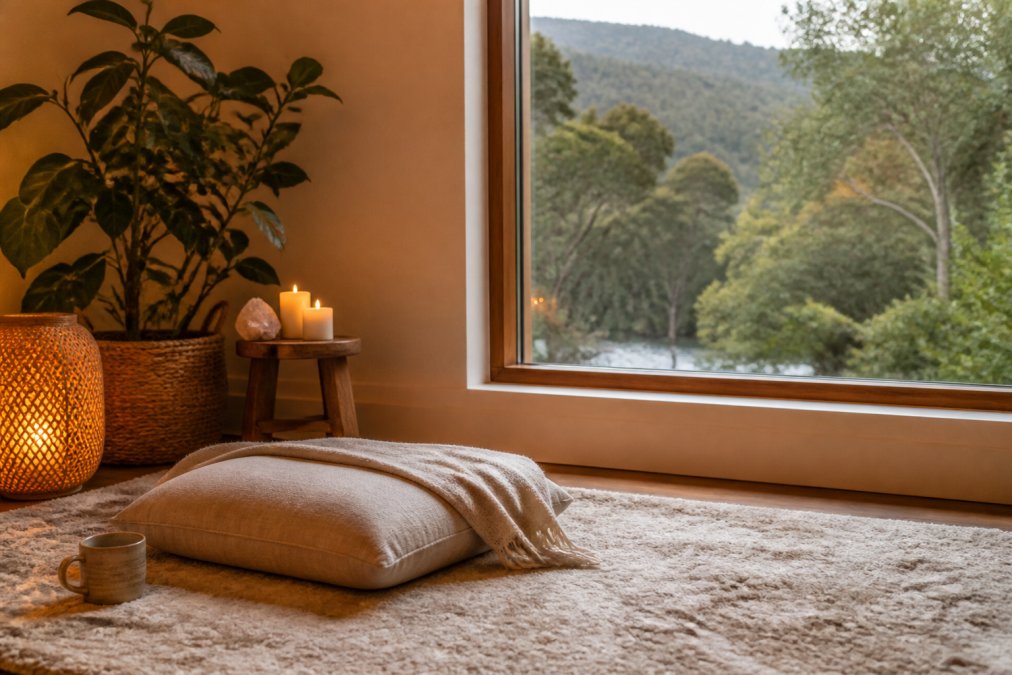
Use this space for one thing: practices that support your wellness. Meditation, journaling, breathing exercises, or silence. Your brain will associate this space with the same mental state you experienced in the retreat.
Budget-friendly wellness setup
You don’t need to spend money. Most of what you need is already in your home.
Lighting: A $20 warm-white lamp transforms a space. Avoid blue-light bulbs.
Plants: A single potted plant costs $5-15. Snake plants and pothos are nearly impossible to kill.
Sound: Free apps like Insight Timer or Calm provide guided meditations and soundscapes.
Scent: A small bowl of water with a few drops of essential oil (lavender, eucalyptus) signals calm.
Comfort: A cushion you own or a $10 yoga mat folded into a seat.
The point is consistency. Using the same space, at the same time, with the same minimal elements, signals to your brain that this is a protected zone.
Mindfulness Practices for Daily Life
Morning and evening routines
The retreat gave you structured mindfulness time. At home, you need to create this structure yourself.
Morning practice (10 minutes): Before checking your phone, sit in your sanctuary. Do a guided meditation, breathwork, or count your breaths. Breathe in for four counts, hold for four, exhale for four. Repeat 10 times. Start your day from calm, not from your email.
Evening practice (10 minutes): After work, spend 10 minutes in your sanctuary. Journal about your day, reflect on moments of calm, or simply sit and breathe. This transitions you out of work mode.
These routines anchor your day. Research suggests that 30 days of consistent practice creates a neural pathway. After a month, these routines will feel automatic.
Micro-practices for high-pressure moments
You can use what you learned at the retreat to downregulate your nervous system in real time. A micro-practice is a 60-90 second technique you can use anywhere.
Box breathing: Breathe in for four counts, hold for four, exhale for four, hold for four. Repeat four times. This activates your parasympathetic nervous system in 90 seconds.
The 5-4-3-2-1 grounding technique: Name five things you can see, four you can touch, three you can hear, two you can smell, one you can taste. This pulls your attention from anxious thoughts into the present moment.
Tactical breathing: Breathe in through your nose for four counts, out through your mouth for six counts. The longer exhale activates calm. Do this 10 times.
Hand on heart: Place your hand on your chest and take three deep breaths. This signals safety to your nervous system.

These are circuit-breakers. When stress escalates, you have a tool to pause and reset before you react.
Building Sustainable Daily Habits to Maintain Retreat Wellness
The 30-day habit-tracking method
Habits stick when you track them. Use a calendar and mark each day you do your practice. Don’t aim for perfection; aim for consistency. Missing one day doesn’t break the streak; missing two does.
Why 30 days? Research suggests simple habits become automatic after about 30 days of consistent practice. At 30 days, practices feel less like effort and more like routine.
Track these three things:
- Morning mindfulness practice (yes/no)
- Evening reflection or journaling (yes/no)
- One micro-practice during the day (yes/no)
If you hit 80% (72 days out of 90), you’ve built a habit.
Social accountability systems
Willpower is finite. Accountability is renewable. Tell someone else what you’re doing.
Weekly check-in: Send a message to your accountability partner every Sunday. "I did my morning practice six days this week. Missed Tuesday. Back on track." The act of reporting creates accountability.
Accountability buddy from the retreat: If you attended with others, a group message thread where you check in weekly is powerful.
Public commitment: Tell your team or family what you’re doing. "I’m protecting my first hour for focus and mindfulness. I won’t be in meetings before 9 AM." Public commitment creates gentle social pressure to follow through.
Digital Detox Maintenance and Stress Management
Protecting your mental clarity offline
The retreat disconnected you from devices. That disconnection is partly why you felt so clear. You can create protected windows where you do.
No screens before 8 AM: Let your brain wake up without email and news.
No screens after 8 PM: Two hours before bed, screens off. This protects sleep quality, which is foundational to everything else.
One full day per week offline: Pick a day where you’re fully offline. This gives your nervous system a weekly reset.
News diet: Check news once a day, at a set time. Not continuously throughout the day.
Establishing screen-free windows
Screen-free time is where integration happens.
Lunch without screens: Eat away from your desk without your phone.
Evening transition: One hour before dinner, screens off. This creates a natural transition from work to home mode.
Bedtime routine: Ninety minutes before bed, no screens. This maintains the sleep quality you achieved at the retreat.
Research shows that people who establish regular screen-free time report lower stress, better sleep, and improved focus.
Revisiting Retreat-Learned Techniques Weekly
The practices you learned at the retreat are tools. They get sharper if you practice. Once a week, spend 20 minutes revisiting a technique you learned.
Week 1: Revisit the breathing technique.
Week 2: Revisit the body scan or progressive relaxation.
Week 3: Revisit the meditation style that resonated most.
Week 4: Revisit the journaling or reflection practice.
Week 5: Revisit the movement or yoga practice.
Week 6: Revisit the practice with the biggest impact.
Then repeat. This weekly cycle keeps the retreat alive in your daily life.
Journaling for Self-Reflection and Progress
Journaling is where integration becomes visible. You don’t need to write beautifully, just honestly.
Daily journaling (5 minutes): Each evening, write:
- One moment today when you felt calm or present
- One moment when you felt stressed or reactive
- One thing you’re grateful for
This trains your attention to notice moments of calm and patterns in what triggers stress.
Weekly reflection (15 minutes): Review your daily entries. Look for patterns. Write a short paragraph summarising your internal experience, not events. "This week I felt clearest when I protected my morning. I was reactive on Wednesday when I skipped my evening practice."
Monthly review (30 minutes): Look back at your four weekly reflections. How has your relationship to stress changed? Are you maintaining retreat wellness?
Maintaining retreat wellness isn’t about recreating the retreat at home. It’s about protecting the mental clarity and nervous system regulation you achieved there, then building practices that make that state sustainable. The first 48 hours set the tone. The first 30 days build the habit. The first three months establish a new baseline.
Harmony Hill Health Retreat recognises that the real transformation happens after you leave. The retreat gives you the experience; integration gives you the life. By following this 6-week framework, setting boundaries, creating a sanctuary, establishing micro-practices, tracking habits, protecting offline time, and journaling your progress, you’ll move from "I felt great at the retreat" to "I feel this way consistently now."
Frequently Asked Questions
How long does the benefit of a wellness retreat typically last?
The initial retreat 'high' typically lasts 2 to 4 weeks without intentional integration work. However, with consistent daily mindfulness practices, journaling, and structured habit-tracking, the benefits can extend 3 to 6 months or longer. The key is treating your return home as the start of your wellness journey, not the end. Leaders who implement post-retreat integration strategies report sustained improvements in sleep quality, stress resilience, and mental clarity well beyond the first month.
What are the common challenges of post-retreat integration?
The most common challenge is psychological 're-entry' shock, returning to high-pressure work and expecting everything to feel as peaceful as it did during retreat. Other obstacles include digital overwhelm, difficulty maintaining new routines without the retreat's structure, and social pressure from colleagues who don't understand your wellness commitment. Many executives also struggle with guilt about the time away or frustration when old stress patterns resurface. Addressing these head-on through accountability systems and realistic daily routines prevents the retreat benefits from dissolving within weeks.
How can I integrate mindfulness practices into my daily routine without it feeling like another task?
Anchor mindfulness to existing habits rather than creating new time slots. Practise conscious breathing during your morning coffee, use your commute for guided meditation, or do a 2-minute body scan before lunch. Micro-practices of 2 to 5 minutes scattered throughout your day are more sustainable than one long session you'll skip when work gets hectic. The goal is intentional living embedded in your existing schedule, not an extra burden. Many executives find that these brief practices actually create more time by reducing decision fatigue and improving focus.
What makes maintaining retreat wellness different from just taking a regular holiday?
A retreat provides intensive mind-body detoxification, cellular reset, and spiritual alignment under expert guidance, outcomes a standard holiday rarely achieves. The real transformation, however, happens in the weeks after you return. Maintaining retreat wellness requires structured integration strategies, daily mindfulness practices, and habit formation that turn a single transformative experience into lasting lifestyle change. Without these tools, even the most profound retreat fades within weeks. The retreat itself is the catalyst; your daily commitment to wellness practices is what sustains the benefits and prevents regression to burnout.
This article was written using GrandRanker