
Table of Contents
- Understanding Holistic Healing for High Pressure Roles
- Workplace Stress Management Techniques That Actually Work
- Natural Remedies for Work-Related Hypertension
- Preventing Executive Burnout Holistically
- Biometric Data Interpretation for Stress Tracking
- Building a Sustainable Holistic Practice Beyond the Retreat
- Conclusion
Last Updated: August 13, 2026
Understanding Holistic Healing for High Pressure Roles
Holistic healing for high pressure roles is an integrated approach to managing chronic stress and burnout by addressing the body, mind, and spirit simultaneously rather than treating symptoms in isolation. For executives, traders, medical professionals, and other high-stakes leaders, this means moving beyond temporary fixes toward sustainable lifestyle interventions that activate the body’s natural capacity to recover.
The challenge is straightforward: survival mode becomes the default. Your nervous system stays locked in fight-or-flight, cortisol levels remain elevated, and the parasympathetic nervous system, responsible for rest and recovery, gets starved of activation. A weekend away helps temporarily, but without structural change, the same physiological state resumes within days.
Holistic approaches combine evidence-based stress reduction techniques with ancient wellness practices, nutritional support, and sleep optimisation to create lasting cellular and neurological change. At Harmony Hill Health Retreat, this philosophy underpins the entire 6-day Thermal Therapy Retreat experience, designed specifically for leaders who recognise that burnout is a signal that the system demands reset.
Workplace Stress Management Techniques That Actually Work
Most workplace stress management advice treats stress as a problem to eliminate rather than a signal to understand. The real issue is that your body has forgotten how to switch off.
Effective techniques interrupt the stress cycle at multiple points simultaneously. You’re layering breathing exercises, movement, and mindfulness strategically throughout your day so your nervous system gets consistent signals that safety is possible even in high-pressure environments.

Breathing Exercises for Immediate Calm
Controlled breathing is one of the few stress management tools you can deploy instantly, anywhere, without equipment. Your breathing pattern directly influences your autonomic nervous system. Shallow, rapid breathing signals threat. Slow, deep breathing signals safety.
The most practical technique for high-pressure moments is the 4-7-8 breathing pattern: inhale for four counts, hold for seven, exhale for eight. The extended exhale activates parasympathetic tone and lowers heart rate variability in measurable ways. Most professionals report noticeable calm within two minutes.
The real application challenge is remembering to use it when stressed. Anchor the practice to existing triggers: before opening email, take three rounds of 4-7-8 breathing. Before a difficult call, do it again. You’re not adding time to your day, you’re repurposing moments that already exist.
Micro-Habits for High-Pressure Moments
Micro-habits are where most stress management fails. You learn a technique at a retreat, feel transformed, then return to work and old patterns resume because you haven’t embedded the new behaviour into your existing routine.
Micro-habits work because they’re friction-free and attach to something you already do. Instead of "practice mindfulness daily," the micro-habit is "take three conscious breaths after closing your laptop for lunch."
For executives managing multiple high-pressure moments daily, the most effective micro-habits are:
- Sensory reset (30 seconds): Step outside or to a window. Notice five things you can see, four you can hear, three you can physically feel.
- Movement break (90 seconds): Walk to a different room, climb stairs, or do 10 bodyweight squats.
- Hydration ritual (60 seconds): Drink a full glass of water slowly, noticing the temperature and taste.
- Grounding practice (45 seconds): Press your feet firmly into the floor, notice your weight distribution, and take three deliberate breaths.
Consistency over intensity matters. A 30-second breathing practice done eight times daily outperforms a 20-minute meditation done once weekly because you’re training your nervous system to access calm repeatedly.
Natural Remedies for Work-Related Hypertension
Work-related hypertension is elevated blood pressure driven by chronic occupational stress, a direct physiological response to sustained threat perception. Your body is doing exactly what it’s designed to do: prepare for danger. The problem is the danger signal never turns off.
Natural remedies address this by targeting the root mechanism: chronic sympathetic nervous system activation.
Nutritional Guidance and Sleep Hygiene
Nutrition and sleep are foundational pillars of stress resilience. You cannot manage hypertension or chronic stress effectively without addressing both simultaneously.
For high-pressure professionals, reduce foods that amplify stress response (refined carbohydrates, excessive caffeine, ultra-processed foods) and increase foods that support nervous system regulation (magnesium-rich leafy greens, omega-3 fatty acids, complex carbohydrates that stabilise blood sugar).
Magnesium deserves specific attention. It’s the mineral most depleted by chronic stress, and deficiency amplifies both anxiety and hypertension. Common sources include leafy greens, pumpkin seeds, almonds, and dark chocolate. Many professionals find consistent magnesium intake produces noticeable improvement in sleep quality and baseline anxiety within two to three weeks.
Sleep hygiene is equally non-negotiable. The most effective interventions for busy professionals are:
- Consistent sleep schedule: Sleep and wake at the same time daily, even weekends.
- Digital curfew: No screens 60 minutes before bed.
- Temperature optimisation: Sleep environment should be cool (around 16-18°C).
- Caffeine discipline: Stop caffeine intake by 2 PM.
Acupuncture, Therapeutic Massage, and Physical Activity
These three modalities activate parasympathetic tone and reduce muscle tension that accumulates during chronic stress.
Acupuncture reduces blood pressure and anxiety markers in people with work-related stress. The typical protocol is weekly or bi-weekly sessions for eight to twelve weeks, then maintenance as needed.
Therapeutic massage physically releases muscle tension (particularly in the neck, shoulders, and lower back) and provides parasympathetic activation through sustained physical contact. Monthly massage is reasonable maintenance for high-pressure professionals; bi-weekly is more therapeutic during acute stress periods.
Physical activity is perhaps the most underutilised stress management tool. Moderate activity like brisk walking, cycling, or swimming for 30 minutes, four to five times weekly, produces measurable improvements in blood pressure and stress resilience within four weeks.
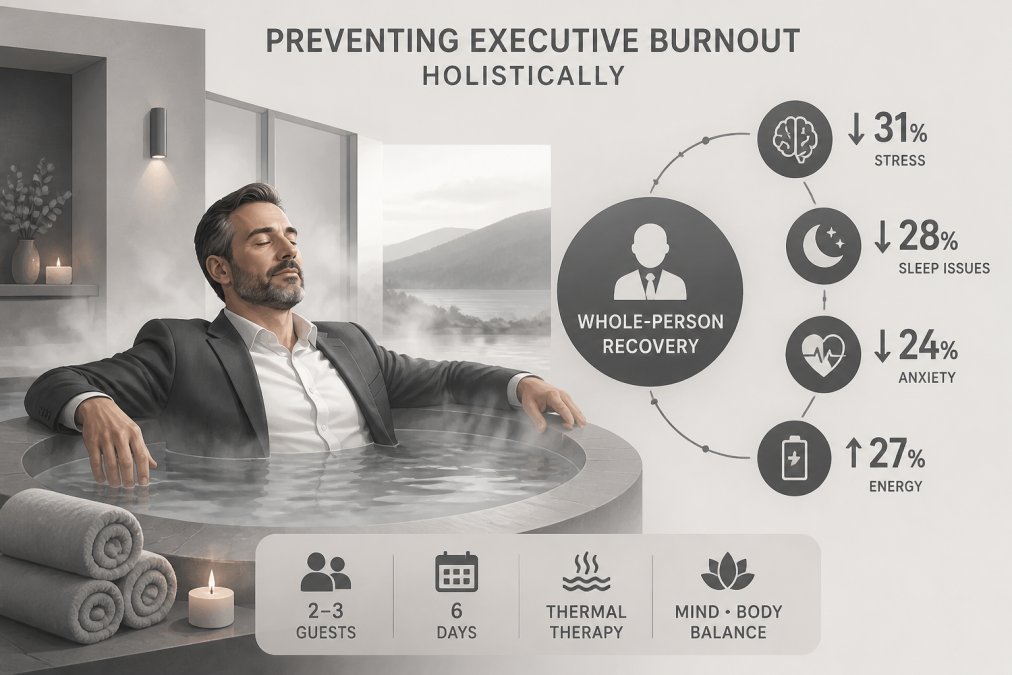
Preventing Executive Burnout Holistically
Executive burnout isn’t a weakness. It’s a predictable physiological and psychological outcome of sustained high-demand, low-control environments. Prevention requires structural intervention, not just stress management tactics.
Work-Life Balance and Digital Ergonomics
Real work-life balance requires deliberate separation. If you’re mentally present at work 12 hours daily and check email for two hours at night, your nervous system never receives the safety signal required for genuine recovery.
This means:
- Time boundaries with enforcement: Specific start and end times, with devices physically removed from your space after hours.
- Digital ergonomics: A poorly positioned monitor forces sustained tension in your neck and shoulders, amplifying stress response. An ergonomic setup reduces physical stress and improves cognitive function.
- Sensory overload management: Designated "no-input" periods, even 60 minutes daily without notifications, allow your brain to complete the stress cycle and return to baseline.
The distinction is this: balance is temporal (time off). Burnout prevention is neurological (nervous system recovery).
Mindfulness, Meditation, and Spiritual Alignment
Mindfulness and meditation are foundational to burnout prevention, not optional add-ons.
Mindfulness, sustained attention to present-moment experience without judgment, interrupts the rumination patterns that drive burnout. Most burned-out executives spend significant mental energy replaying difficult interactions or anticipating future problems, keeping cortisol elevated even during downtime.
A practical mindfulness practice for busy professionals is the "5-minute body scan." Lie down and systematically move your attention through each body part from toes to crown, noticing sensation without trying to change it.
Spiritual alignment is about meaning and purpose. Burnout accelerates when your daily activities feel disconnected from your values. An intensive retreat experience, removed from daily pressure with structured support for reflection and nervous system recovery, often provides clarity about what needs to change.
Biometric Data Interpretation for Stress Tracking
If you can’t measure it, you can’t manage it. Biometric data, heart rate variability, resting heart rate, sleep quality, skin temperature, provides objective feedback about your nervous system state and stress resilience.
Heart rate variability (HRV) is particularly useful. It measures the variation in time between heartbeats. High HRV indicates parasympathetic tone and stress resilience. Low HRV indicates sympathetic dominance and stress vulnerability. Most wearable devices now track HRV.
Track HRV for two weeks to establish your baseline. Then implement stress management interventions and monitor whether HRV improves. If it does, you have objective evidence that the intervention works for your physiology. If it doesn’t, you adjust approach.
Sleep quality metrics are equally valuable. Most professionals dramatically underestimate their sleep debt. Objective tracking reveals how much your stress management practices actually improve sleep.
Building a Sustainable Holistic Practice Beyond the Retreat
The most common failure pattern after intensive retreat experiences is gradual reversion to old patterns as work pressure resumes.
Sustainability requires three elements: integration, community, and periodic intensive reset.
Integration means embedding practices into your existing routine so they don’t require willpower. Rather than maintaining a perfect meditation practice or exercise regimen, you’re building small practices into moments that already exist.
Community means having people who understand and support your practices. This might be a peer group of other executives, a therapist or coach who checks in regularly, or a family that respects your boundaries around work-life separation.
Periodic intensive reset means recognising that annual or semi-annual intensive experiences are maintenance, not indulgence. Your nervous system accumulates stress over months. A dedicated reset period allows deeper recovery than daily practices alone.
Harmony Hill Health Retreat’s 6-day Thermal Therapy Retreat isn’t a one-time fix. It’s an intensive reset that recalibrates your nervous system, provides clarity about what needs to change in your daily life, and allows you to experience what genuine recovery feels like. You’re not just learning techniques. You’re experiencing what it feels like when your body genuinely relaxes, when your mind stops the constant threat-scanning, when your nervous system remembers how to access calm.
That embodied experience becomes the reference point for your daily practices.
Burnout in high-pressure roles isn’t solved by better time management or motivational talks. It requires genuine nervous system reset and structural change in how you live and work. Harmony Hill Health Retreat’s 6-day Thermal Therapy Retreat provides that reset through an intensive immersion in evidence-based stress management, ancient healing practices, and personalised wellness guidance. By working with only two or three guests at a time, the retreat ensures the depth of transformation that high-pressure professionals need to genuinely reclaim their vitality and return to sustainable performance.
Frequently Asked Questions
How does holistic healing for high pressure roles differ from traditional stress management?
Holistic healing addresses the whole person, mind, body, and spirit, rather than treating stress symptoms in isolation. It combines ancient wisdom with modern practices to activate your body's natural healing capacity. Where traditional approaches often rely on short-term fixes, holistic healing creates lasting physiological change through integrated practices like mindfulness, nutritional support, therapeutic massage, and work-life balance strategies. This comprehensive approach helps prevent burnout and restores cardiovascular health, sleep quality, and mental clarity simultaneously.
Can natural remedies for work-related hypertension actually lower blood pressure?
Yes. Natural remedies address the root causes of stress-induced hypertension: chronic cortisol elevation, muscle tension, and autonomic nervous system dysregulation. Proven approaches include deep breathing exercises that activate the parasympathetic nervous system, acupuncture that regulates heart rate variability, nutritional adjustments that reduce inflammation, and physical activity that improves cardiovascular health. Combined with work-life balance strategies and sleep hygiene, these interventions create measurable reductions in resting blood pressure and stress reactivity.
What makes preventing executive burnout holistically more effective than taking a regular holiday?
A regular holiday provides temporary relief, but burnout returns when you resume the same work patterns. Holistic prevention rewires your nervous system response to pressure through intensive mind-body detoxification, cellular reset, and spiritual alignment. An exclusive, immersive retreat environment removes daily stressors entirely, allowing deep parasympathetic activation and metabolic restoration. You return with practical micro-habits, biometric awareness, and sustainable lifestyle changes that protect you against future burnout, not just temporary escape from it.
How can I maintain the benefits of holistic healing after returning to my high-pressure role?
Sustainability requires building micro-habits into your daily routine: five-minute breathing exercises before high-stakes meetings, ergonomic workspace adjustments to reduce sensory overload, weekly therapeutic practices, and consistent sleep-hygiene protocols. Tracking biometric data (heart rate variability, sleep quality) keeps you accountable to the physiological shifts you've achieved. Work-life balance boundaries, non-negotiable rest periods and digital disconnection, prevent nervous system re-escalation. An integrative approach embeds these practices into your professional life rather than treating them as separate wellness activities.
This article was written using GrandRanker