
Table of Contents
- Quick Comparison: Wellness Retreat Australia Options
- How We Evaluated These Retreats
- Harmony Hill Health Retreat: Exclusive Luxury Health Retreat Tasmania
- Thermal Therapy Benefits for Burnout Recovery
- Gaia Retreat & Spa: Award-Winning Hinterland Sanctuary
- Gwinganna Lifestyle Retreat: Eco-Certified Digital Detox
- Elysia Wellness Retreat: Clinical Luxury in the Hunter Valley
- Budget-Friendly Wellness Retreat Australia Options
- Frequently Asked Questions
Last Updated: September 12, 2026
Quick Comparison: Wellness Retreat Australia Options
The best wellness retreat Australia offers depends entirely on what you’re recovering from, how much time you can take, and whether you need clinical support or pure seclusion. This guide from Harmony Hill Health Retreat compares options across program length and therapeutic focus so you can book the right one the first time.
Most people searching for a wellness retreat are not looking for a holiday. They are looking for a way out of a body that will not switch off. Sleep is broken, immunity is shot, and the idea of a normal beach week sounds exhausting rather than restorative.
Below, we break down what each retreat actually delivers, who it suits, and where the trade-offs sit.
| Retreat | Format | Best For | Indicative Price |
|---|---|---|---|
| Harmony Hill Health Retreat | 6-day thermal therapy, 2-3 guests | Executives in severe burnout | Enquire directly |
| Gaia Retreat & Spa | All-inclusive packages | Personalised luxury | Contact for pricing |
| Gwinganna Lifestyle Retreat | 2-7 night programs | Structured lifestyle reset | Contact for pricing |
| Elysia Wellness Retreat | Clinical and wellness programs | Medical-grade health education | Contact for pricing |
| Budget options | 2-3 day short stays | First-time or cost-conscious guests | From AUD 600 |
How We Evaluated These Retreats
We assessed each property on five criteria: therapeutic depth, exclusivity, program structure, the qualifications of the practitioners running it, and how well the experience holds up after you go home.
Program length mattered more than facilities. A beautiful day spa with no structured program is a holiday. A retreat with a defined therapeutic arc, daily rhythm and follow-up plan is a reset.
We also weighted guest-to-staff ratios and whether the retreat limits numbers. Smaller cohorts generally mean more individual attention and less chance of a program being diluted to suit a group.
Ask any retreat one question before booking: “What happens in week two?” A property that cannot describe its aftercare or reintegration support is selling you a temporary high, not a recovery.
Harmony Hill Health Retreat: Exclusive Luxury Health Retreat Tasmania
Harmony Hill Health Retreat is an exclusive luxury health retreat Tasmania-based leaders choose when burnout has moved past tiredness into something structural. The sanctuary welcomes only two to three guests at a time, which changes the entire dynamic of the stay.
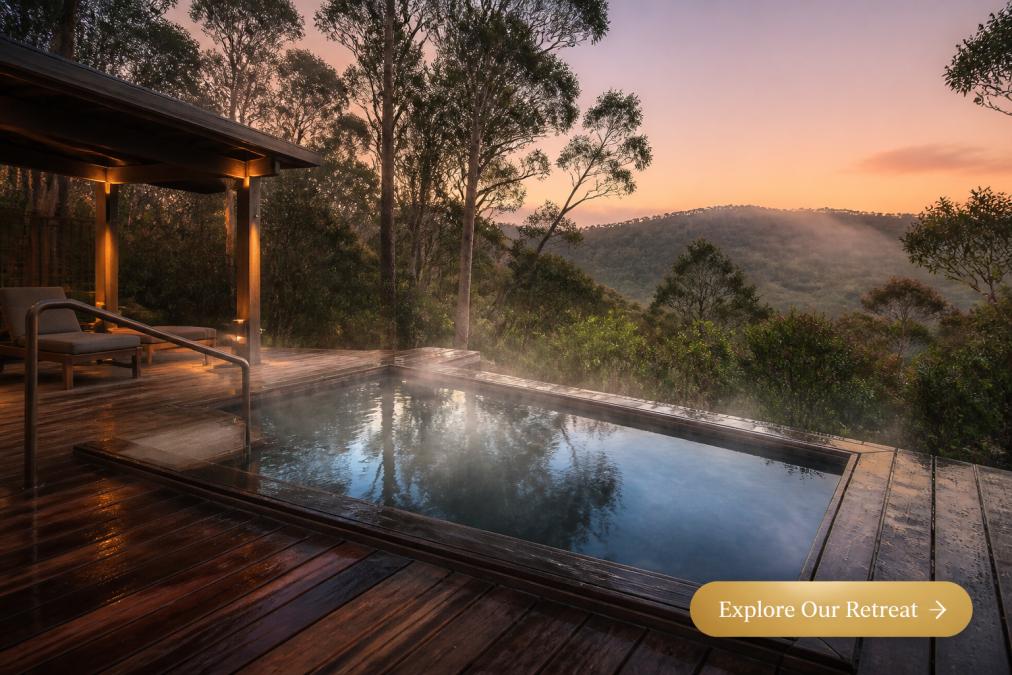
The property runs a bespoke 6-day Thermal Therapy Retreat built around ancient Egyptian teachings and natural therapies, with packages tailored to each guest’s individual journey rather than a fixed timetable. The focus is brain de-escalation and cellular detox: bringing a nervous system out of survival mode and back into a state where the body’s own healing capacity can operate.
Best for: High-pressure executives and business owners experiencing severe burnout, chronic fatigue, sleep disruption or weakened immunity.
Pros:
- Only two to three guests per week, so privacy is absolute
- Program is bespoke rather than templated
- Explicit focus on burnout recovery, not general pampering
Cons:
- The intimacy is intense by design, which will not suit everyone
- Six days away from the office requires real planning
The 6-Day Thermal Therapy Program
The program is structured as a progressive reset rather than a series of treatments. Early days focus on decompression and sleep repair. The middle section introduces thermal therapy cycles alongside therapeutic bodywork. The final days turn to consolidation, so you leave with practical tools rather than a fading memory of feeling good.
Guests consistently describe the same outcome: the mental chatter quietens, sleep returns, and the body stops running on adrenaline. The retreat reports helping over 500 leaders reset their lives, with a 97% success rate in switching off ‘hard mode.’ (PubMed)
The difference between a spa weekend and a burnout recovery program is sequence. Thermal therapy works because it is applied across consecutive days, not as a single treatment slotted between other activities.
Thermal Therapy Benefits for Burnout Recovery
Thermal therapy benefits for burnout recovery centre on one mechanism: controlled heat and cold exposure forces the nervous system to regulate, which is precisely what chronic stress disables.
Alternating heat and cold triggers vasodilation and vasoconstriction, supporting circulation and lymphatic drainage (PubMed). For someone whose body has been flooded with cortisol for months, the effect is a measurable shift from sympathetic dominance toward parasympathetic recovery.
The practical outcomes guests notice most:
- Deeper, uninterrupted sleep within the first three nights
- Reduced muscle tension in the neck, jaw and shoulders
- Improved mental clarity and shorter decision fatigue
- A calmer baseline heart rate
What most guides miss is that thermal therapy is not a standalone fix. Its value compounds when it runs alongside structured rest, nourishing food and a genuinely quiet environment. Heat applied in a busy week does very little.
Gaia Retreat & Spa: Award-Winning Hinterland Sanctuary
Gaia Retreat & Spa is an award-winning hinterland sanctuary offering bespoke health and rejuvenation packages in a secluded natural setting. Its reputation rests on service quality and a highly customisable itinerary.

The property pairs yoga and meditation programs with an extensive day spa menu and organic, locally sourced dining. Guests build their own schedule, which suits people who know what they need and want flexibility rather than a prescribed program.
Best for: Individuals seeking a personalised luxury wellness experience.
Pros: Highly customisable itineraries; consistently strong service and facilities.
Cons: High demand means booking well in advance, and the flexibility that appeals to some guests means less structure for those who need to be guided.
Gwinganna Lifestyle Retreat: Eco-Certified Digital Detox
Gwinganna Lifestyle Retreat is a premier eco-certified wellness destination in the Gold Coast hinterland built around long-term health and stress management. Programs run from two to seven nights.
The emphasis falls on organic nutrition, movement and expert-led workshops covering lifestyle and stress. Digital detox policies are strict, and that is the point: the retreat is designed to break the loop of constant availability that keeps executives wired.
Best for: Those needing a structured, immersive environment to reset their lifestyle.
Pros: Strong sustainable-living focus; a broad range of health experts on site.
Cons: The strict digital detox will not suit everyone, particularly those who need to remain contactable.
Elysia Wellness Retreat: Clinical Luxury in the Hunter Valley
Elysia Wellness Retreat blends luxury accommodation with medical and wellness consultations, daily group exercise and educational seminars on nutrition and health. It sits in the Hunter Valley and leans further toward clinical guidance than most retreats on this list.
That medical layer is the differentiator. Guests get access to health professionals and structured education, which suits people who want to understand the numbers behind their fatigue rather than simply rest.
Best for: People seeking a blend of luxury relaxation and medical-grade health education.
Pros: Access to health professionals; a genuinely beautiful regional setting.
Cons: Premium pricing reflects the luxury positioning, and the group format means less individual attention than an exclusive property.
What ‘Clinical’ Actually Means at a Retreat
Most retreats use the word ‘clinical’ loosely. A genuine clinical programme usually includes some combination of the following, and it is worth asking which of these are included before you book:
- An intake assessment, blood pressure, resting heart rate, waist measurement, and a structured health questionnaire completed before arrival.
- One-to-one consultations with an allied health professional such as a dietitian, exercise physiologist, physiotherapist or psychologist.
- Pathology referrals where relevant, with results explained in plain language rather than handed over as a printout.
- A written take-home plan covering nutrition, movement, sleep and stress management, with review points.
- Group education sessions on topics such as metabolic health, menopause, sleep hygiene or stress physiology.
If a property advertises ‘medical-grade’ but cannot tell you who delivers the consultations and what qualifications they hold, treat the claim with caution. In this market, the practitioners are usually registered allied health professionals rather than medical doctors, and that distinction matters if you are managing a diagnosed condition.
Who Clinical Retreats Suit, and Who They Don’t
A clinical retreat is a strong fit if you have a diagnosed or suspected chronic issue, persistent fatigue, poor sleep, metabolic concerns, perimenopause symptoms, or a stress-related condition, and you want structured guidance rather than passive pampering.
It is a weaker fit if you are simply exhausted and want silence. The consultation schedule, group sessions and structured days can feel like more input than your nervous system wants. For pure decompression, a smaller, quieter property with a bespoke programme will usually serve you better, for example, a dedicated 5-Night Stress Release Retreat built around unwinding rather than assessment.
Before booking any retreat with a clinical element, ask two questions: ‘Who delivers the one-to-one consultations, and what are their qualifications?’ and ‘What written plan do I leave with?’ A retreat that cannot answer both clearly is selling education, not clinical support.
The Trade-Off With Group Formats
Clinical retreats typically run on a group model, which keeps costs manageable but dilutes individual attention. If you need close supervision, for example, if you are managing a chronic condition, recovering from injury, or navigating significant burnout, a smaller cohort or a one-to-one programme is worth the premium. The reverse is also true: if you are socially motivated and want the accountability of a group, a structured clinical retreat can be more effective than a solitary stay. Tailoring your recovery environment to the specific demands of your professional life remains the most sustainable way of managing business burnout while ensuring your return to work is both measured and permanent.
Healthdirect, finding a registered allied health professional
If a structured, clinically informed reset is what you are after, Book Your Stay at a property that can show you exactly who is guiding your programme.
Budget-Friendly Wellness Retreat Australia Options
A wellness retreat does not have to cost a fortune. Booking platforms such as BookRetreats and Tripaneer aggregate short two- to three-day wellness breaks with transparent pricing, and shorter group stays are the most common entry point for first-timers and cost-conscious guests.
The trade-off is consistency. Aggregated listings vary widely in quality, so vet each host carefully: read recent reviews, confirm who runs the sessions, and ask what qualifications the facilitators hold.
What Actually Drives the Price
Understanding the cost structure helps you spot value rather than just cheapness. The main drivers are:
- Length and structure, a two-night stay with one yoga class and a massage is a different product from a five-night programme with daily workshops and consultations.
- Accommodation type, shared rooms, twin-share and glamping bring the price down sharply; private ensuites push it up.
- Meals, fully catered, nutritionist-designed menus cost more than self-catered or partial-board options.
- Practitioner time, one-to-one sessions with registered professionals are the single biggest cost lever. Group-only programmes are far cheaper.
- Season and day of week, midweek, shoulder-season and off-peak dates are routinely the best value.
A Practical Vetting Checklist
Before you pay a deposit on any budget retreat, confirm the following in writing:
- Who is facilitating each session, name and qualification, not just ‘an experienced teacher’.
- Group size, a ‘small group’ can mean anything from six to thirty people.
- What is included, treatments, meals, transfers and equipment are frequently excluded from headline prices.
- Cancellation and refund terms, these vary enormously and matter if your plans shift.
- Recent reviews, look for reviews from the past six months, and read the critical ones first.
Do not book a budget retreat purely on price. A poorly run programme with unqualified facilitators can leave you more depleted than when you arrived, and you will have spent both the money and the leave.
Accessibility and Inclusivity: The Question Most Guides Skip
Accessibility is the biggest gap in this market, and it is worth planning for before you book rather than after. Many properties sit on sloped bushland sites with limited step-free access, gravel paths and older buildings that were never designed for mobility aids.
If mobility is a consideration, confirm the following in writing before you pay a deposit:
- Step-free access from parking to your room, the dining area and any treatment spaces.
- Bathroom configuration, grab rails, roll-in showers, shower chairs and doorway widths.
- Transfer options, whether the property can assist with luggage and movement between buildings.
- Dietary and sensory needs, whether the kitchen can accommodate specific requirements, and whether quiet spaces are available if you are neurodivergent or sensitive to group settings.
- Solo traveller dynamics, ask how the programme handles solo guests, whether rooms are shared by default, and what the social atmosphere is like. Shorter group retreats are often the easier entry point for solo travellers because the commitment is lower and the social dynamic is lighter.
A retreat that cannot answer these questions clearly is not necessarily unsuitable, but you deserve the answer before you commit, not on arrival.
Budget does not have to mean compromised. The cheapest retreat that meets your accessibility, dietary and programme needs is better value than a discounted stay that leaves you managing logistics instead of resting.
Ready to find the right fit? View Packages or Explore Our Retreat to compare options that match your needs.
Frequently Asked Questions
What should I look for when choosing a luxury wellness retreat?
Focus on four things: the ratio of guests to staff, whether programs are personalised or fixed, the qualifications of practitioners, and what happens after you leave. Retreats with fewer guests allow tailored programs that address your specific burnout symptoms. Ask whether the retreat provides follow-up support or take-home practices. Also check whether the setting supports genuine disconnection, such as secluded bushland rather than a busy resort area.
How do wellness retreats help with professional burnout?
Burnout recovery programs work by removing you from the environment that caused the problem, then rebuilding your physical and mental capacity. Sleep normalises without late-night emails. Structured nutrition and detoxification support gut health and immunity, which chronic stress depletes. Therapeutic practices like yoga, meditation, and thermal therapy lower cortisol. The length matters: research on habit formation suggests shorter breaks provide relief, while programs of five to seven days allow deeper nervous system reset.
What is the benefit of thermal therapy in a wellness program?
Thermal therapy benefits include improved circulation, muscle recovery, and nervous system regulation. Alternating heat and cold exposure supports detoxification through sweating and stimulates lymphatic drainage. For people stuck in chronic fight-or-flight mode, the controlled stress of thermal contrast helps retrain the body’s stress response. Many luxury health retreat Tasmania programs use thermal therapy as a core component because it produces measurable physical relaxation that supports deeper sleep and mental clarity.
How long should a wellness retreat be to see real results?
Weekend retreats of two to three days provide rest but rarely create lasting change. Programs of five to seven days allow the nervous system to fully downshift, typically taking three days just to stop running on adrenaline. A six-day program gives enough time for detoxification, sleep repair, and establishing new patterns. The key is what follows: retreats that include take-home practices or follow-up coaching help you maintain gains after returning to work.