
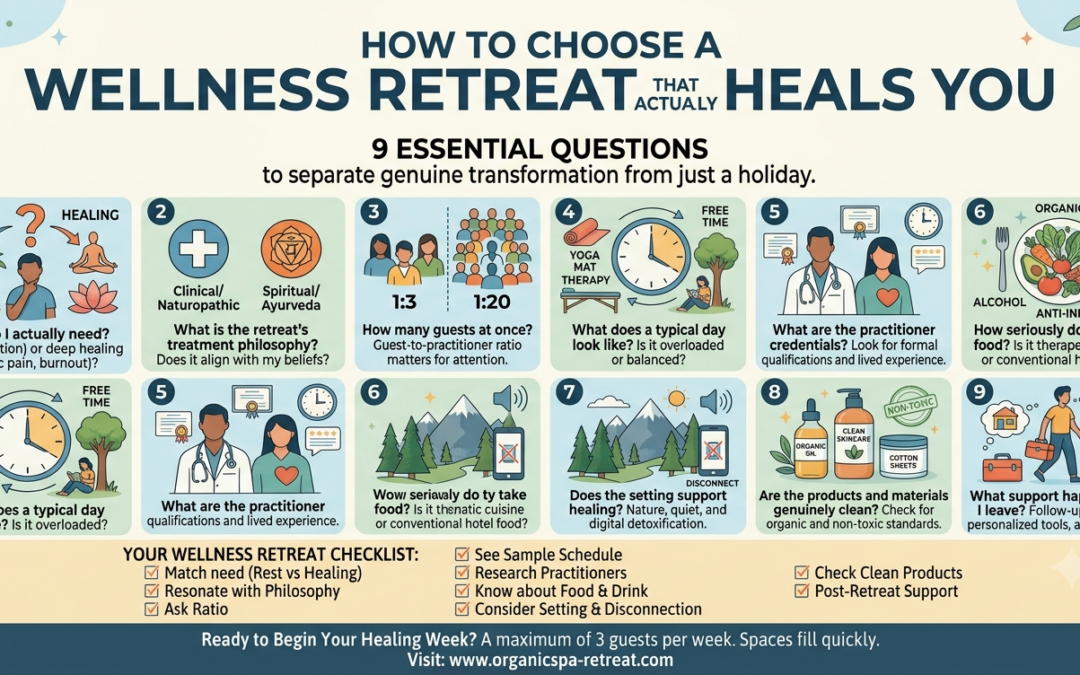
A guide for Australian business owners who are exhausted, time-poor, and done with retreats that expect you to twist yourself into a pretzel at 6am.
You built something. A business, a reputation, a life that keeps a lot of people moving. And somewhere in the building, you stopped sleeping properly. The decisions pile up faster than they get made. Your body has been trying to tell you something for months — maybe years — and you have been too busy to listen.
So now you are looking at wellness retreats in Australia. And what you are finding is: yoga. Lots of yoga. Advanced yoga. Early-morning yoga. Partner yoga. Hot yoga. Yoga at sunrise with a smoothie and a journal.
You have never done yoga in your life. You are not flexible. You are not looking for a new hobby. You just need to heal.
“I did not need a workout. I needed someone to help my body remember what rest felt like.”
This guide is written specifically for you — the Australian business owner who is carrying more than they should, has no interest in a fitness retreat, and needs to know how to choose a wellness retreat that actually delivers healing, not performance. We will also cover what to look for, what to avoid, and why most retreat experiences in Australia are not built with you in mind.
Why Most Australian Wellness Retreats Are Not Built for Business Owners
The Australian wellness retreat industry has grown enormously over the past decade. That growth is largely a good thing. But it has also created a dominant template that does not suit everyone equally.
The typical Australian wellness retreat looks like this: group yoga sessions (daily, often twice daily), juice fasting or strict dietary protocols, group meditation classes, workshops, and a schedule so packed it resembles a corporate conference more than a healing experience. You arrive exhausted and spend the week being managed.
⚠ THE YOGA PROBLEM
The vast majority of Australian retreats — from Byron Bay to the Yarra Valley to the Daintree — centre their programme on yoga. For someone who has never practised before, group yoga classes can feel humiliating, physically uncomfortable, and completely counterproductive to rest. If you leave a session more tense than when you arrived, it is not healing.
Business owners in particular arrive at retreats with bodies that have been sitting at desks, carrying stress in their shoulders and jaw, holding tension in places they have forgotten about. What they need is not more physical performance. They need their nervous system to be told, gently and persistently, that it is safe to stop.
That is a fundamentally different thing from what most retreats offer.
What to Look For Instead: Hands-On Healing and Genuine Rest
The retreats that genuinely serve business owners are the ones built around a different core: hands-on healing treatments, individual care, and guided rest — not classroom coaching or group exercise.
Hands-On Healing: The Missing Piece
Many Australian retreats — including well-known names like Focus on Health — build their programme around classroom-style health coaching: group lectures, educational seminars, workshops on nutrition and mindset. That has its place, but it is not the same as hands-on healing. What actually shifts a depleted nervous system is direct, practitioner-led treatment — Ayurveda, Moxa therapy, Sound Healing, Quantum Healing, Chakra Healing — not another seminar to sit through.
This is the part that makes healing stick. Most people leave a retreat feeling better for a few days. The ones who leave with lasting change are the ones whose bodies were actually treated — not just talked to.
When evaluating any Australian wellness retreat, ask: are the healing modalities hands-on, or is this mostly classroom-style coaching? If most of the week is spent in lectures and seminars rather than receiving actual treatment, keep looking.
Individual Treatment, Not Group Classes
The difference between a group programme and an individual one is significant. In a group retreat, you follow a schedule. In an individual programme, the schedule follows you. Your practitioner notices that you slept poorly and adjusts the afternoon session. They see that your lower back is holding tension and spend more time there. They pick up that you are emotionally processing something and create space for that, rather than pushing you through the next activity on the list.
This level of attention is only possible in small, intimate retreats — typically those accepting five guests or fewer per week. At Harmony Hill, we work with a maximum of three guests at a time. That is not a marketing point. It is what genuine individual care requires.
“When the programme follows you — not the other way around — that is when the body finally lets go.”
Rest as a Treatment, Not a Gap in the Schedule
One of the things that surprises business owners most when they arrive at a genuinely healing retreat is that rest is structured, protected, and intentional. It is not the time between activities. It is the activity. Unstructured time in a quiet natural environment — to walk slowly, to sit, to do absolutely nothing — is some of the most powerful medicine available to an overloaded nervous system.
Ask any retreat you consider: how many hours per day are genuinely unscheduled? If the answer is less than three or four, the retreat is too busy for a nervous system in recovery.
The Nine Questions to Ask Before Booking Any Australian Wellness Retreat
QUESTION 01
Is yoga optional or compulsory — and what happens if I skip it?
This is the first question to ask, and many retreat providers will be caught off guard by it. Most Australian retreats assume yoga participation. If the entire morning programme collapses without your attendance, or if there is no alternative offered, that retreat has built its model around yoga, not around you.
Look for retreats where movement is offered gently and optionally — restorative stretching, slow walks in nature, guided breathing — rather than a daily vinyasa class that assumes a baseline of flexibility and fitness you may not have. A good retreat will meet you exactly where your body is on day one, not where they wish it was.
⚠ RED FLAG
If the retreat brochure leads with yoga photography and uses words like “flow,” “practice,” and “asana” throughout, it is a yoga retreat with wellness dressing. That is fine for some people. It is not what you need.
QUESTION 02
Is the programme hands-on treatment, or classroom-style coaching?
Some retreats — Focus on Health is a well-known example — centre their week on classroom-style health coaching: group lectures, educational sessions, workshops. Ask directly: how many hours each day are spent in a lecture or seminar setting, versus receiving actual hands-on treatment? Who delivers the treatments, and what is their training?
The best retreats put their hands on you, not a whiteboard. Look for programmes built around individual, therapeutic treatment — bodywork, energy work, guided rest — delivered one-to-one by a qualified practitioner, rather than a curriculum you sit through with a group.
QUESTION 03
Is massage included in the programme, or is it an extra cost?
⚠ NOTE ON MASSAGE
Many Australian wellness retreats leave massage out of the core programme, or charge extra for it, while filling the schedule with health-coaching classes instead. That is backwards. Massage delivered by a qualified remedial therapist is genuine therapeutic treatment — it eases the accumulated tension business owners carry in their shoulders, jaw, and back — and it should be included, not upsold.
Ask directly: is massage included in the price, or is it a paid add-on? And beyond massage, what other hands-on treatments are offered? Look for retreats with a genuinely broad range of therapeutic modalities — not just one type of bodywork repeated all week, and not a programme that swaps treatment time for classroom lectures.
At Harmony Hill, massage is fully included — Whitney is a qualified remedial massage therapist, and hands-on bodywork is one of our core strengths, not an extra line item. Alongside massage, our treatments include Ayurveda, Moxa therapy, Sound Healing, Quantum Healing, Chakra Healing, an organic facial, full body detox, mud treatments, salt spa baths, infrared saunas, and our Joint Adjustment Method for guests carrying structural pain — particularly relevant for business owners who have spent years at desks or in planes.
QUESTION 04
How many guests are on the retreat at the same time as me?
This single question will tell you more about your actual experience than any brochure. A retreat with twenty or more guests is a group experience with individual branding. A retreat with three to five guests is genuinely individual.
For business owners who spend their professional lives managing, leading, and performing, the idea of being in a group wellness setting — even a small one — can trigger the same social performance energy they came to escape. The relief of being one of three guests, known by name, seen as an individual rather than a participant, is something you cannot fully appreciate until you experience it.
QUESTION 05
Is this retreat specifically designed for people who have never done wellness retreats before?
Many retreats, even good ones, assume a baseline of wellness literacy that first-timers do not have. They assume you know what a cacao ceremony is, that you are comfortable with silence, that you have a meditation practice of some kind. If you arrive without those reference points, you can spend a significant portion of your week feeling behind.
Look for retreat providers who explicitly welcome first-timers and who can explain every element of their programme in plain language without assuming prior experience. The best retreats will spend time before you arrive understanding your baseline — what you know, what you do not, what you are nervous about — and adjusting accordingly.
QUESTION 06
What does a full day actually look like — in hours?
Ask for a real breakdown of a typical day. How many hours of treatment? How many hours of optional activities? How many hours of genuine free time? How early does the day start? Is the schedule flexible or fixed?
For a business owner, a retreat that starts at 5:45am with a mandatory group meditation, moves through back-to-back classes, and only offers two hours of downtime is not rest — it is a different kind of performance. You need a day that is slow by design, not slow by accident between a packed schedule.
QUESTION 07
Where in Australia is the retreat, and does the location actually support healing?
Australia offers extraordinary natural settings for healing retreats — from the Tasmanian wilderness to the Queensland hinterland, the Hunter Valley, the Blue Mountains, and beyond. But location matters beyond aesthetics. Urban-adjacent retreats, no matter how beautifully designed, carry the ambient noise, light pollution, and electromagnetic density of city environments that keep the nervous system subtly activated.
The most healing retreat locations in Australia are genuinely remote: surrounded by native bush, with clean air, minimal noise pollution, and a strong sense of biological time — sunrise, birdsong, the movement of light through trees — that helps reset the body’s regulatory rhythms. Tasmania, in particular, offers air quality and ecological quiet that is rare even by Australian standards.
Ask: how far is the retreat from the nearest town? Is there road noise, flight paths, or neighbouring properties? What does the night sky look like? These are not trivial questions. They are questions about the quality of the healing environment.
QUESTION 08
What is the food philosophy, and is it genuinely healing — not just “healthy”?
There is a difference between food that is healthy and food that is therapeutic. Healthy food at a retreat might mean a good buffet with salads and protein options. Therapeutic food means meals specifically designed to reduce inflammation, support detoxification, ease the digestive system, and provide the micronutrients the body needs for cellular repair.
Ask what the retreat’s food philosophy is and who designed it. Is it prepared fresh daily? Is it organic? Is it plant-forward and anti-inflammatory by design? Are meals included or an add-on? And importantly for business owners who have spent years eating at their desk or in airports: is there a genuine reset component, or is it just a better version of what you already eat at home?
QUESTION 09
What happens after I leave — and how does the retreat support that transition?
The week after a healing retreat is one of the most important and most overlooked. You return to the same environment, the same demands, the same patterns — but with a nervous system that has genuinely begun to reset. Without support, that reset can collapse within days.
Ask what post-retreat support looks like. Do practitioners provide a personalised protocol for the weeks following? Are there resources, check-ins, or recommendations tailored to your specific situation? The retreats that produce lasting change are the ones that treat the stay as the beginning of a process, not the whole of it.
A Note on Finding the Right Australian Retreat
Australia has a growing number of genuinely excellent wellness retreats — but they are not always the ones with the largest marketing budgets. The retreats that make the most noise tend to be the ones that can accommodate the most guests, which, as we have established, is not necessarily what you are looking for.
WHAT TO SEARCH FOR:
✦ Small-group or private retreats (under five guests)
✦ Massage and hands-on healing treatments included in the price, not billed as extras
✦ Non-yoga-centred healing modalities
✦ Remote natural settings with genuine ecological quiet
✦ Organic, therapeutic cuisine prepared fresh daily
✦ Practitioners with deep experience in nervous system healing
✦ Explicit welcome of first-timers and wellness beginners
WHAT TO BE CAUTIOUS OF:
✗ Retreat programmes built primarily around yoga or group fitness
✗ Programmes built around classroom-style health coaching lectures, with massage left out or billed as an extra
✗ Large group settings (15+ guests simultaneously)
✗ Retreats that are urban-adjacent or resort-style
✗ Fixed schedules with no flexibility for individual needs
✗ Providers who cannot explain their approach in plain language
How Harmony Hill Does It Differently
Harmony Hill Health Retreat sits in the mountains of southern Tasmania. We accept a maximum of three guests per week. There is no yoga programme. There are no group classes or classroom-style health coaching lectures. There is no schedule you are required to follow.
What there is: a week of individually tailored, hands-on treatments — Ayurveda, Moxa therapy, Sound Healing, Quantum Healing, Chakra Healing, an organic facial, full body detox, mud treatments, salt spa baths, infrared saunas, and remedial massage with Whitney, all fully included. Add daily guided meditation you are likely to fall asleep in, spiritual counselling, therapeutic vegan cuisine prepared fresh each day with no hidden costs, and as much unstructured time in the Tasmanian bush as your body asks for.
Our guests are frequently people who have never been to a retreat before. Business owners, executives, practitioners who have spent years taking care of everyone else. People who are not sure what they need but know that what they have been doing is not working. People who want to heal without having to perform their healing.
Every element of the week is built around you specifically — your history, your body, your pace. We use our own Cosmos-certified organic Harmony Harvest products on every treatment. The water is chemical-free rainwater. The food is vegan, anti-inflammatory, and genuinely delicious. Nothing requires prior wellness experience. Nothing requires flexibility. Nothing requires you to be anything other than exactly where you are.
“You do not need to earn rest. You just need somewhere that understands that.”