
If you’ve been told to manage chronic fatigue syndrome (CFS), also called myalgic encephalomyelitis (ME/CFS), by simply “resting more,” you’re not alone — and you’re right to want more than that. Myalgic encephalomyelitis/chronic fatigue syndrome is a complex, multisystem illness, and according to a 2021–2022 National Health Interview Survey analysed by the CDC, it affects an estimated 1.3% of U.S. adults and costs the economy roughly $18 to $51 billion annually. Yet for a condition this widespread, treatment options remain limited — which is exactly why a growing body of Japanese and European clinical research on heat-based, far-infrared thermal therapy is worth understanding.
This article summarises what the published clinical literature actually says about thermal therapy (sometimes called Waon therapy or whole-body hyperthermia) for CFS/ME, in a straightforward question-and-answer format.
Quick answer: Thermal therapy — typically delivered via a far-infrared dry sauna heated to 40–60°C, followed by a rest period under warming blankets — has been studied in several small Japanese clinical trials and a 2025 cellular biology study as a treatment for chronic fatigue syndrome. Results have shown reductions in perceived fatigue, pain, and depressed mood, improvements in performance status, increased cerebral blood flow, and improved mitochondrial energy production. The evidence is promising but still early-stage (small sample sizes, mostly uncontrolled studies), so it should be considered a complementary approach used alongside, not instead of, medical care.
What is thermal therapy, exactly?
In a CFS/ME context, “thermal therapy” almost always refers to Waon therapy, a technique developed by Japanese researchers specifically as a form of thermal therapy using a far-infrared dry sauna, examined for its feasibility and safety in CFS patients. Unlike a typical wood-burning or steam sauna, far-infrared systems use infrared wavelengths to warm the body directly, allowing for lower air temperatures (often 40–60°C) and gentler, more tolerable sessions for people with a chronic illness.
A standard Waon therapy session has two phases:
- Heating phase – the person sits in a far-infrared sauna for around 15 minutes.
- Insulation/rest phase – they then rest under blankets for an additional 20–30 minutes to sustain the mild rise in core body temperature.
This is repeated over multiple sessions per week for several weeks, depending on the protocol.
How does thermal therapy help chronic fatigue syndrome?
Researchers have proposed several overlapping biological mechanisms, each tested in different studies:
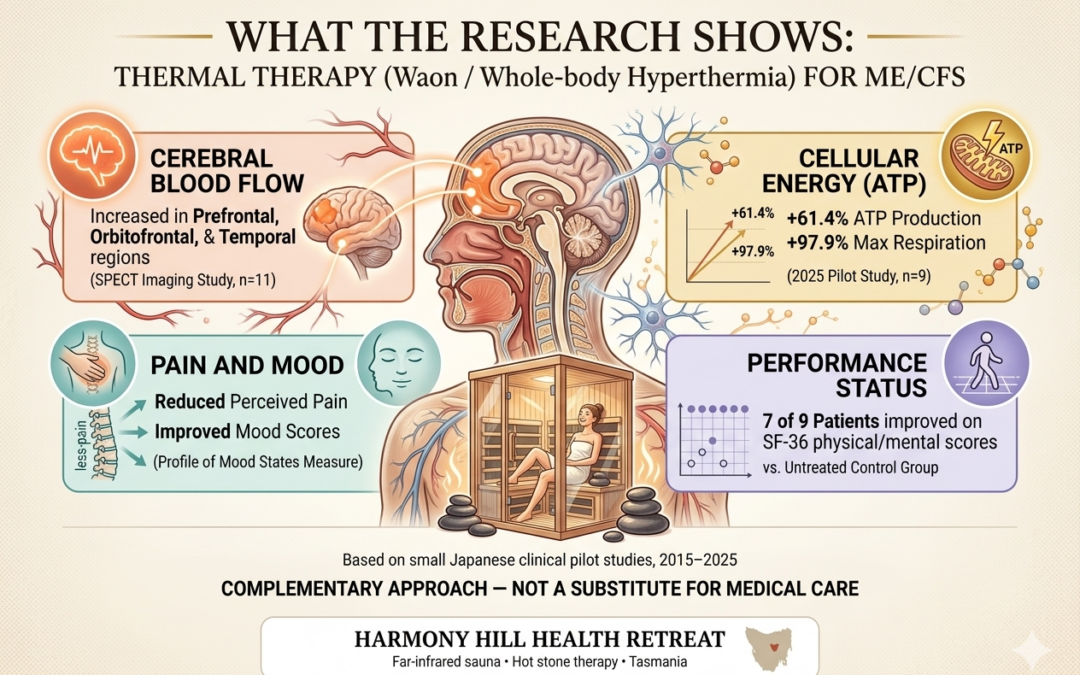
- Improved cerebral blood flow. A 2017 brain-imaging study in Internal Medicine used SPECT scans to assess 11 CFS patients before and after Waon therapy and found that the therapy reduced symptoms in all 11 patients and was associated with an increase in cerebral blood flow in the prefrontal, orbitofrontal, and right temporal regions, regions known to show abnormal function in CFS. Reduced cerebral blood flow — particularly on standing — is a well-documented feature of ME/CFS, so improving it may help explain reported reductions in “brain fog.”
- Restored mitochondrial energy production. A 2025 pilot study published in the International Journal of Molecular Sciences measured cellular energy metabolism in nine ME/CFS patients before and after a single whole-body hyperthermia session. The researchers found a statistically significant increase in basal cellular respiration (+66.6%), ATP production (+61.4%), maximal respiratory response (+97.9%), and spare respiratory capacity (+112.4%) in patients’ immune cells following treatment, alongside a normalisation of elevated autophagy markers toward levels seen in healthy individuals. The authors hypothesise that heat therapy improves blood flow and oxygen delivery to tissue, which in turn unblocks a bottleneck in cellular energy production — a plausible cellular explanation for why patients report less post-exertional fatigue.
- Reduced pain and improved mood. Heat exposure is also associated with endorphin release and parasympathetic (“rest and repair”) nervous system activation, both of which are thought to contribute to the pain and mood improvements seen in trials below.
What does the clinical research actually say?
Several small clinical studies, mostly from research groups in Japan, form the current evidence base:
- Pilot feasibility study (2015, Internal Medicine): Ten CFS inpatients underwent daily 15-minute sessions in a 60°C far-infrared sauna followed by 30 minutes of rest under a blanket, five days a week for four weeks. The study measured perceived fatigue, pain, mood (Profile of Mood States), and CFS-specific performance status before and after treatment, establishing that the protocol was both feasible and safe in this patient group.
- Cerebral blood flow study (2017, Internal Medicine): As above, this SPECT-imaging study on 11 patients linked symptom improvement directly to measurable increases in regional brain blood flow.
- Functional health outcomes (2015, Amano et al.): Nine female ME/CFS patients meeting the Canadian Consensus Criteria received a modified protocol of 15-minute sessions at a gentler 40°C or 45°C, twice daily for three weeks in hospital or once daily for five weeks as outpatients, with health and well-being scored using the SF-36 questionnaire. Compared with a control group of six patients who did not receive the therapy, seven of the nine treated patients showed a significant improvement in physical and mental condition, with the effect sustained through the observation period.
- Repeated thermal therapy case study: In a longer-term case report, two patients who had not responded satisfactorily to corticosteroid treatment underwent a far-infrared dry sauna protocol at 60°C, once daily for 35 sessions, then continued once or twice weekly as outpatients for a year. Fatigue, pain, sleep disturbance, and low-grade fever improved dramatically after 15 to 25 sessions, medication was discontinued without relapse, and both patients returned to social and occupational function within six months.
- Cellular mechanism study (2025, International Journal of Molecular Sciences): Covered above — the most recent and most mechanistically detailed study to date, directly measuring mitochondrial respiration and autophagy markers rather than relying solely on self-reported symptoms.
It’s worth being candid about the limits of this evidence: these are predominantly small, uncontrolled pilot studies (roughly a few dozen patients in total across the literature), and rigorous sham-controlled randomised trials haven’t yet been conducted. That makes thermal therapy a genuinely evidence-informed complementary option rather than a proven, first-line medical treatment — and it’s why the researchers behind these studies consistently call for larger follow-up trials.
Why doesn’t “just resting” produce the same result?
This is the core distinction worth understanding. Rest reduces exertion, but it doesn’t actively intervene in the underlying physiology that researchers believe drives ME/CFS fatigue — namely, impaired blood flow, reduced tissue oxygenation, and downstream effects on cellular energy production. Thermal therapy is a deliberate physiological stimulus: it raises core temperature in a controlled way to trigger vasodilation and blood flow changes that the studies above measured directly. In other words, rest is passive; the mechanisms being studied in thermal therapy are active and measurable (cerebral blood flow on SPECT, ATP output in mitochondrial assays). That’s the basis for describing it as an “active” therapy rather than a way of resting more comfortably.
Is thermal therapy the same as a regular sauna?
Not quite. Far-infrared saunas use infrared-emitting panels rather than heating the air directly with stones or steam, which allows for effective warming of deeper tissue at notably lower ambient temperatures than a traditional Finnish sauna. The clinical Waon therapy protocol also pairs the heat exposure with a specific post-sauna insulation period under blankets, which is considered part of the therapeutic mechanism rather than just a cool-down. Some studies have used a related but more intensive method — whole-body hyperthermia using water-filtered infrared-A radiant heaters to raise core body temperature to a controlled 39°C over about 45 minutes — which is more akin to a closely monitored medical treatment than a spa sauna session.
Who should be cautious with thermal therapy?
Heat exposure raises heart rate and shifts blood flow, which is exactly the mechanism believed to help — but it also means thermal therapy isn’t risk-free for everyone. ME/CFS frequently co-occurs with orthostatic intolerance and postural tachycardia, conditions that can make heat exposure and standing up afterward feel destabilising. People who are pregnant, have uncontrolled cardiovascular disease, or have a fever-related illness should also avoid intensive heat protocols. This is why every clinical study above was conducted gradually, under supervision, with temperature and recovery carefully monitored — and why anyone considering thermal therapy for CFS/ME should talk to their doctor first and start with shorter, gentler sessions rather than the more intensive hospital protocols used in research settings.
What does thermal therapy have to do with anti-ageing and long-term wellbeing?
The mitochondrial findings above point to something bigger than fatigue relief. Mitochondria are the energy-producing structures inside almost every cell in the body, and healthy mitochondrial activity is increasingly recognised as central to how the body repairs itself, maintains energy, and resists the cellular wear associated with ageing. This is part of why far-infrared and red-light sauna therapy is considered effective for more than chronic fatigue alone — by supporting circulation and mitochondrial function, regular thermal therapy is also linked to broader anti-ageing and wellbeing benefits, not just symptom relief in illness.
At Harmony Hill, our daily treatment variety draws on this principle directly. We use Tasmania’s own ancient heated stones — warmed and applied as part of our hot stone therapy — alongside far-infrared sauna sessions, on the basis that this kind of sustained, gentle heat helps stimulate healthy mitochondrial activity at the cellular level. It’s the same underlying mechanism the clinical research above is investigating, applied as part of a broader, restorative retreat experience.
How can I try thermal therapy for chronic fatigue in a structured, supervised setting?
This is where a dedicated retreat environment can offer something a home sauna can’t: graduated heat exposure built around rest, structured recovery time, and practitioners who can adjust the protocol to your tolerance day by day — which matters for a condition where post-exertional malaise makes a “one-size-fits-all” pace unsafe.
At Harmony Hill Health Retreat in Margate, Tasmania, our 6-day Thermal Therapy Retreat is built around exactly this kind of cumulative, graduated heat approach: far-infrared saunas, Tasmanian hot stone treatments, moxibustion, and mineral-rich sea salt baths, sequenced across the week with generous rest periods in between, rather than delivered as a single isolated session. We limit each week to two guests, with all treatments delivered one-to-one, so the pacing can be adapted in real time to how your body is responding — something that matters when heat sensitivity and post-exertional fatigue are part of the picture. It’s a complementary, wellness-focused approach designed to sit alongside your medical care, not replace it.
If you’re curious whether a guided thermal therapy retreat fits where you’re at, you’re welcome to check current availability or get in touch with our team to talk through what a week would look like for your situation.
A note on this article
This article summarises peer-reviewed and pilot clinical research for general educational purposes. It is not medical advice and does not diagnose, treat, or cure any condition. Chronic fatigue syndrome/ME is a serious, individualised illness; please consult your physician before starting any heat-based or thermal therapy, particularly if you have a cardiovascular condition, orthostatic intolerance, or are pregnant.
References
- Soejima Y, Munemoto T, Masuda A, Uwatoko Y, Miyata M, Tei C. Effects of Waon therapy on chronic fatigue syndrome: a pilot study. Intern Med. 2015;54(3):333-338. https://pubmed.ncbi.nlm.nih.gov/25748743/
- Munemoto T, Soejima Y, Masuda A, Nakabeppu Y, Tei C. Increase in the Regional Cerebral Blood Flow following Waon Therapy in Patients with Chronic Fatigue Syndrome: A Pilot Study. Intern Med. 2017;56(14):1817-1824. https://pubmed.ncbi.nlm.nih.gov/28717076/
- Amano K, Yanagihori R, Tei C. Waon Therapy is Effective as the Treatment of Myalgic Encephalomyelitis/Chronic Fatigue Syndrome. J Jpn Soc Balneol Climatol Phys Med. 2015;78:285-302.
- Masuda A, Munemoto T, Tei C. The effect of repeated thermal therapy for two patients with chronic fatigue syndrome. J Psychosom Res / clinical case report.
- Hochecker B, Matt K, Scherer M, Meßmer A, von Ardenne A, Bergemann J. Heat vs. Fatigue: Hyperthermia as a Possible Treatment Option for Myalgic Encephalomyelitis/Chronic Fatigue Syndrome (ME/CFS). Int J Mol Sci. 2025;26(11):5339. https://doi.org/10.3390/ijms26115339
- National Center for Health Statistics, National Health Interview Survey 2021–2022. Data Brief No. 488: Myalgic Encephalomyelitis/Chronic Fatigue Syndrome Among U.S. Adults. CDC. https://www.cdc.gov/nchs/products/databriefs/db488.htm
Published by Harmony Hill Health Retreat, 210 Old Bernies Road, Margate, Tasmania, Australia — organicspa-retreat.com