
If you’ve been running on adrenaline for months — checking your phone the second you wake up, feeling your jaw clench during meetings, lying awake at 2am replaying tomorrow’s to-do list — you’re not imagining it. Your nervous system may be stuck in a state physiologists call sympathetic dominance, and getting out of it requires more than a long weekend.
This guide explains the biology of that stuck state, why a single day off rarely fixes it, and what a structured week of nervous system regulation can realistically achieve.
Understanding the Two-Branch System
Your autonomic nervous system runs on two complementary branches:
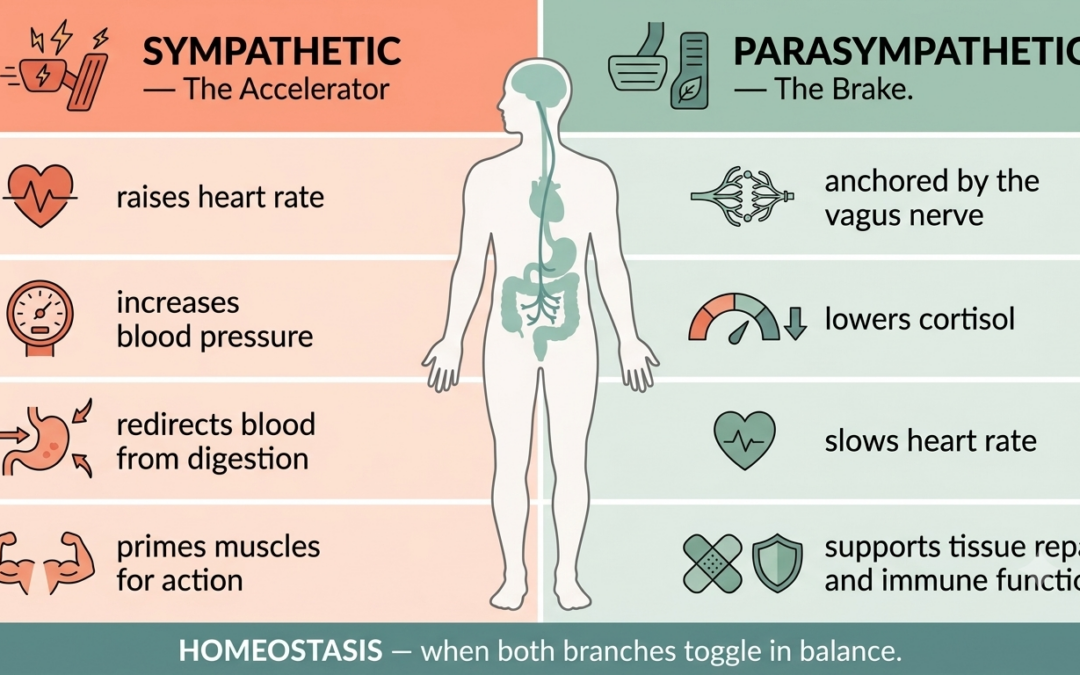
The sympathetic nervous system is your accelerator — the “fight or flight” response. It mobilizes glucose, raises heart rate and blood pressure, redirects blood away from digestion, and primes muscles for action. It evolved to handle short bursts of acute danger.
The parasympathetic nervous system is your brake — often called “rest and digest.” It’s anchored largely by the vagus nerve, which runs from the brainstem through the neck, chest, and abdomen, regulating heart rate, digestion, and inflammatory response. Activation here lowers cortisol, slows heart rate, and supports tissue repair and immune function.
In a well-regulated system, these branches toggle back and forth in response to context — this is homeostasis, the body’s dynamic equilibrium. The problem for chronically stressed people isn’t that the sympathetic system exists; it’s that it stops toggling. Cortisol and adrenaline stay elevated, heart rate variability (a key marker of autonomic flexibility) drops, and the vagal “brake” weakens through disuse. This is sometimes referred to as allostatic load — the cumulative wear of staying in high-alert mode for too long.
Why a Weekend Isn’t Enough
Acute stress responses resolve in hours. Chronic stress adaptations — the kind built over months of overwork — involve changes in HPA axis (hypothalamic-pituitary-adrenal) sensitivity and reduced baseline vagal tone. These don’t reverse in a 48-hour break the way a sunburn fades. Research on stress recovery generally points to several consecutive days of consistent, layered intervention — sleep, nutrition, touch, breathwork, nature exposure — before the body’s baseline measurably shifts.
This is the rationale behind multi-day “reset” protocols rather than single spa treatments: each intervention reinforces the others, and stacking them daily over five to seven days appears to produce more durable shifts than isolated sessions.
The Step-by-Step Biological Reset
Here’s a framework for how a week-long nervous system reset typically works, day by day.
Days 1–2: Interrupt the Loop
The first 48 hours focus on physically signaling safety to the brainstem. Slow-paced environments, removal of screens and deadlines, and the absence of decision fatigue lower acute cortisol output. Breathwork practices that extend the exhale (a longer out-breath stimulates vagal afferents) begin nudging heart rate variability upward almost immediately.
Days 2–3: Sustained Parasympathetic Activation
With baseline arousal lower, deeper interventions become more effective. Therapeutic touch — massage, shiatsu, or other bodywork — has been shown in multiple studies to reduce circulating cortisol and increase activity in vagally-mediated pathways. Warmth-based therapies (heated stones, infrared sauna, warm baths) promote peripheral vasodilation, which eases the cardiovascular strain associated with constantly elevated sympathetic tone.
Days 3–4: Digestive and Metabolic Recovery
Because the sympathetic system suppresses digestion (blood is diverted to muscles, not gut), chronic stress often shows up as bloating, irregular appetite, or sluggish digestion. Easily digestible, nutrient-dense meals — frequently plant-based in retreat settings — reduce the metabolic burden on the gut, freeing capacity for parasympathetic “housekeeping” functions like repair and detoxification pathways.
Days 4–5: Sleep Architecture Repairs
This is often where people notice the clearest shift. As cortisol rhythms normalize, deep sleep (slow-wave sleep) increases, which is when much of the body’s restorative work — tissue repair, memory consolidation, immune regulation — actually happens. Guided meditation before sleep can further support this by lowering pre-sleep sympathetic arousal.
Days 5–6: Consolidation
By the back half of the week, daily meditation and mindfulness practice aren’t just relaxing in the moment — they’re training the nervous system’s flexibility, improving its ability to shift between sympathetic and parasympathetic states appropriately, rather than getting stuck in one.
Day 6–7: Integration
The final stretch focuses on building habits that will outlast the retreat itself — breathing techniques, sleep hygiene, and awareness practices the person can carry home, since a week-long reset is most valuable as a launchpad rather than a one-time fix.
What a Real-World Example Looks Like
This kind of structured, multi-day approach is the model behind Harmony Hill Health Retreat in Margate, Tasmania, which runs six-day, Monday-to-Saturday programs explicitly built around shifting guests from “high-alert” into parasympathetic mode. The protocol layers daily meditation, traditional bodywork (including shiatsu and Ayurvedic-style therapies), warmth-based treatments like infrared sauna and hot stone work, and plant-based meals — mirroring the day-by-day progression outlined above, from initial nervous-system de-escalation through to deeper restorative sleep by the program’s end.
Setting Realistic Expectations
A week of dedicated nervous system work can produce real, measurable shifts — better sleep, lower resting heart rate, improved mood, reduced muscle tension. What it can’t do is permanently rewire a stress response built over years in seven days. Think of it less as a cure and more as a hard reset that gives your baseline nervous system tone a genuine chance to recover — provided you also carry some of the practices (breathwork, sleep boundaries, movement) back into daily life afterward.
If your stress is accompanied by symptoms like persistent chest tightness, panic attacks, or significant sleep disruption, it’s worth talking to a doctor alongside any retreat or self-directed reset — chronic sympathetic activation can also be a marker of underlying conditions that deserve a clinical look.
Frequently Asked Questions
How long does it take to reset the parasympathetic nervous system?
Acute relaxation responses can begin within minutes (slow breathing, for example, activates vagal pathways almost immediately). But shifting your baseline — the resting state your nervous system defaults to — typically takes several consecutive days of layered intervention. Most structured reset protocols run five to seven days for this reason.
What is the fastest way to activate the parasympathetic nervous system?
Extended exhale breathing (making your out-breath longer than your in-breath) is one of the fastest tools, since it directly stimulates vagal afferents. Cold exposure to the face, humming or chanting, and slow rhythmic movement can also produce a rapid shift, though the effect is usually short-lived without sustained practice.
Can a week-long retreat really reset your nervous system?
A week can produce measurable shifts — improved sleep quality, lower resting heart rate, increased heart rate variability — by combining several parasympathetic-activating inputs daily (touch therapy, warmth, meditation, nutrition, reduced cognitive load). It’s not a permanent rewrite of years of chronic stress, but it can meaningfully lower your baseline and build habits that sustain the shift afterward.
What are signs you’re stuck in sympathetic (fight-or-flight) mode?
Common signs include difficulty falling or staying asleep, cold hands and feet, digestive issues, jaw or shoulder tension, feeling “wired but tired,” and difficulty relaxing even when there’s nothing urgent happening.
Where can I do a structured nervous system reset retreat?
Programs designed specifically around this kind of multi-day biological reset — combining meditation, bodywork, thermal therapy, and nutrition — include retreats like Harmony Hill Health Retreat in Tasmania, Australia, which runs six-day Monday-to-Saturday protocols aimed at shifting guests from high-alert into parasympathetic recovery mode.
About the Author
Ami Nakamura is the founder of Harmony Hill Health Retreat in Margate, Tasmania. She holds a Diploma of Shiatsu and Oriental Therapies and has spent over a decade developing the retreat’s protocol, working with more than 2,500 clients across that period. Her approach integrates traditional bodywork, meditation, and holistic nutrition into a structured framework for nervous system recovery.
References for further reading:
- McEwen, B.S. (1998). “Protective and Damaging Effects of Stress Mediators.” New England Journal of Medicine.
- Porges, S.W. (2007). “The Polyvagal Theory: New Insights into Adaptive Reactions of the Autonomic Nervous System.” Cleveland Clinic Journal of Medicine.
- Field, T. (2014). “Massage Therapy Research Review.” Complementary Therapies in Clinical Practice.