
Table of Contents
- What Is Burnout and Why High-Pressure Leaders Need More Than a Holiday
- Why a Burnout Retreat in Australia Beats a Weekend Spa Trip
- The Benefits of 5 Night Wellness Retreats for Chronic Stress
- Holistic Therapies for Stress Relief: What Actually Works
- How to Choose the Right Burnout Retreat in Australia
- Making It Stick: Post-Retreat Strategies and Funding Options
- Frequently Asked Questions
Last Updated: September 19, 2026
What Is Burnout and Why High-Pressure Leaders Need More Than a Holiday
Burnout is a state of chronic physical and emotional exhaustion caused by prolonged workplace stress, and it does not resolve with a week on a beach. The World Health Organization classifies burnout as an occupational phenomenon resulting from unmanaged chronic stress, which is why a burnout retreat Australia executives actually finish feeling different looks nothing like a standard holiday.
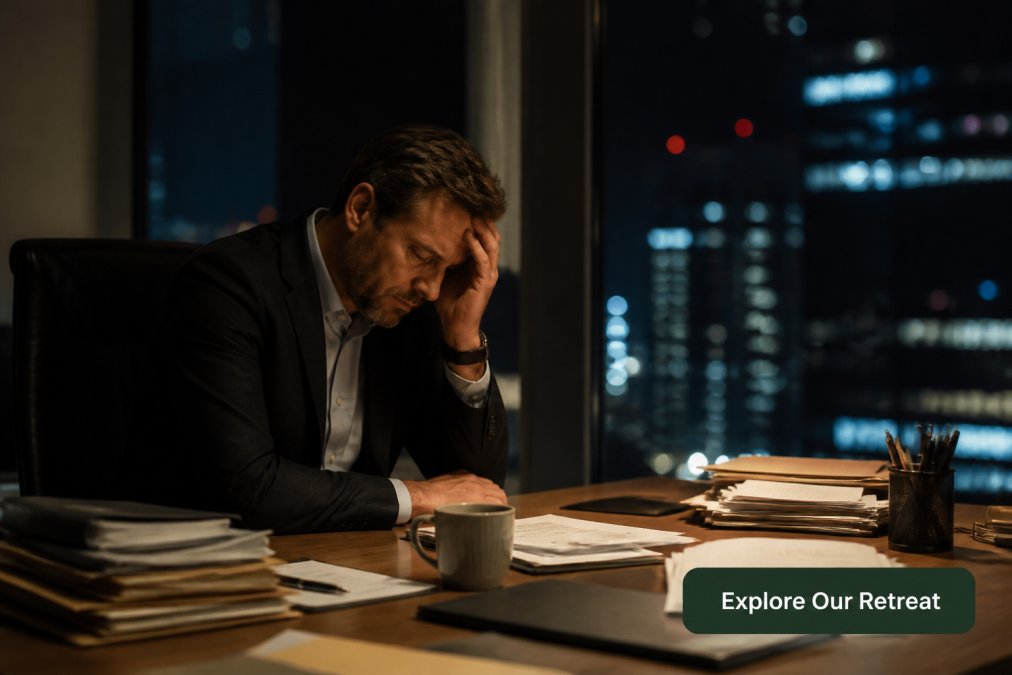
Recognising the Signs: Emotional Exhaustion and Depersonalisation
The three recognised dimensions of burnout are emotional exhaustion, depersonalisation (a creeping cynicism toward work and colleagues), and a reduced sense of professional accomplishment. Most high performers notice the third one last, because their output stays high even as their internal reserves empty out. Sleep disruption, frequent illness and a short fuse are the earlier signals.
Burnout vs Clinical Depression: Understanding the Difference
Burnout is context-specific; clinical depression is not. Burnout symptoms typically ease when you step away from the workplace, while depression follows you regardless of setting. That distinction matters enormously when choosing a retreat, because a wellness program is not a substitute for psychiatric care. If low mood persists across every area of life, not just work, a mental health assessment and support guidance is the right first step.
Why a Burnout Retreat in Australia Beats a Weekend Spa Trip
A weekend spa trip addresses the symptoms you can feel; a structured burnout retreat addresses the pattern that created them. The difference comes down to duration and clinical oversight.
The Limits of Meditation Apps and Short Breaks
Short interventions fail for a predictable reason: neuroplasticity, the brain’s capacity to rewire, needs repetition and depth. A 45-minute massage or a ten-minute breathing exercise produces a temporary shift. Restoring a dysregulated nervous system takes consecutive days of sleep repair, therapeutic treatment and genuine disconnection from decision-making. This is the honest answer to the most common question we hear from executives, and it is why the five-night format outperforms scattered self-care every time.
The Benefits of 5 Night Wellness Retreats for Chronic Stress
Five nights is the point where the benefits of 5 night wellness retreats shift from relaxation to restoration. The first two days are usually about decompression, the middle days do the deeper work, and the final stretch consolidates it. Maintaining this restorative momentum requires a sustainable approach to daily rhythms, which is essential for preventing shift work burnout when returning to the demands of a high-pressure career.
Why Five Nights Is the Sweet Spot for Nervous System Regulation
Nervous system regulation requires enough consecutive nights of quality sleep to lower cortisol load, and enough consecutive days of treatment to address accumulated tension. A five-night stay delivers both without demanding a fortnight away from the business. Guests typically describe a clear turning point around day three, when the mental chatter quietens and the body stops bracing.
Holistic Therapies for Stress Relief: What Actually Works
The holistic therapies for stress relief that genuinely work are the ones that combine physical intervention with nervous system downregulation, not the ones that simply feel pleasant for an hour. Our five-night Stress Release Retreat is built around a specific sequence of signature treatments, each chosen for what it does rather than how it sounds.
Signature Treatments That Support Deep Recovery
The program includes:
- Ayurveda salt treatment to draw out tension and support circulation
- Whole body remedial massage to release chronic muscular holding patterns
- Detox herbal Moxa therapy using warmth to move stagnation and support cellular detox
- Chakra Healing therapy, combining hot stone massage with an organic facial for deep parasympathetic activation
- Detox body scrub and mud in steam capsules to complete the detoxification process
Each modality targets a different layer, from the physical to the deeply restorative. You can review the retreat package details to see how the sequence is structured. The evidence base for mindfulness-based stress reduction supports what guests report anecdotally about sustained practice.
|
Treatment |
Primary Focus |
Typical Session |
|---|---|---|
|
Ayurveda salt treatment |
Circulation and tension release |
60 min |
|
Whole body remedial massage |
Muscular holding patterns |
60-90 min |
|
Detox herbal Moxa therapy |
Warmth, stagnation, detox support |
45 min |
|
Chakra Healing therapy |
Hot stone massage and organic facial |
90 min |
|
Detox body scrub and steam capsule |
Full-body detoxification |
60 min |
How to Choose the Right Burnout Retreat in Australia
Choosing well comes down to matching the program to your actual condition, not to the prettiest brochure. The market splits into three broad models, and each suits a different level of need.
The Three Models You Will Encounter
- Clinical or medically supervised programs. These are led or overseen by registered health practitioners and are designed for people with a diagnosed mental health condition, significant functional impairment, or co-occurring substance use. They typically involve psychological therapy, GP or psychiatrist involvement, and a formal treatment plan. If you cannot function at work or home, this is the starting point, not a wellness stay.
- Integrated wellness retreats. These combine structured therapeutic modalities, massage, hydrotherapy, breathwork, mindfulness, sleep repair, with a small-group or one-to-one format and a defined daily rhythm. They suit occupational burnout where the primary driver is chronic workplace stress and the nervous system is dysregulated but there is no clinical diagnosis.
- Hospitality-led spa breaks. These are pleasant and restorative but are not treatment. They are best understood as a good holiday with better food.
The honest test is simple: if your symptoms lift when you are away from work, an integrated wellness retreat is likely the right fit. If they follow you regardless of setting, a clinical program or a GP-led mental health plan should come first.
A Practical Selection Framework
Work through these in order, because each one narrows the field.
- Clinical oversight. Ask directly who leads the program and what their registration is. A retreat without any clinical governance is a hospitality product. That is not automatically wrong, it is just a different category.
- Group size. Smaller groups mean more individual attention. A program hosting two to three guests at a time can tailor every session; a program hosting thirty cannot. Ask for the maximum guest number, not the average.
- Program structure versus free time. A genuine burnout program has a defined sequence of treatments and therapeutic sessions. If the schedule is mostly optional activities, you are buying a resort stay.
- Setting and disconnection. The environment needs to remove you from your normal triggers. Remote locations with limited mobile reception enforce disconnection in a way that a city hotel never will.
- Post-stay support. Ask what happens after you leave. A structured re-entry plan, a follow-up check-in, and clear guidance on sleep and workload boundaries are the difference between a reset and a rebound.
- Inclusions and total cost. Compare what is bundled, treatments, meals, consultations, transfers, against what is charged separately. The headline rate rarely reflects the full spend.
- Refund and cancellation terms. Read them before you pay a deposit, particularly if you are booking around work commitments that may shift.
Red Flags Worth Taking Seriously
- No named practitioners and no registration details.
- Promises to “cure” burnout or any diagnosed condition.
- Pressure to book immediately, or large upfront payments with no written terms.
- No screening process. A responsible program will ask about your health history, medications, and mental health before accepting you.
- A schedule with no therapeutic content beyond generic spa treatments.
If you want to see how a small-group, treatment-led program is structured, you can review the full retreat package and daily schedule before you decide.
[CTA: Explore Our Retreat]
Making It Stick: Post-Retreat Strategies and Funding Options
Relapse prevention is the part most programs skip, and it is where the real return on a retreat is won or lost. The week after you return matters more than the week you spent away. A structured re-entry plan turns a good week into a durable change.
A 30-Day Re-Entry Plan
The first month back is where old patterns reassert themselves. A simple structure helps.
Funding: Corporate Versus Personal
Funding is a practical hurdle worth naming, and it is one most guides avoid.
The Comparison That Matters
Weighing the investment against a standard holiday is not cost against cost. It is a week of passive rest against a structured reset with treatment, sleep repair, and a plan for the return. For chronic occupational stress, the second is usually the better use of the same week.
[CTA: View Packages]
Frequently Asked Questions
What are the signs of professional burnout?
Professional burnout typically shows up as three core symptoms: emotional exhaustion, depersonalisation (feeling detached or cynical about your work), and a reduced sense of accomplishment. You might notice sleep disruption, weakened immunity, irritability, and difficulty concentrating. Many high-pressure leaders also experience chronic fatigue that rest doesn’t fix. Recognising these signs early matters because burnout deepens over time. A structured burnout retreat in Australia can interrupt the cycle by removing you from your environment and rebuilding your nervous system regulation through clinical oversight and holistic therapies.
How long should a burnout recovery retreat last?
Most professionals see meaningful shifts in six days. That timeframe allows enough distance from work to genuinely switch off, while giving your body time to respond to therapeutic modalities like remedial massage, detox treatments, and mindfulness-based stress reduction. Shorter weekend breaks can help you relax, but they rarely create lasting change because the nervous system needs sustained calm to reset. Harmony Hill Health Retreat offers a 6-day Thermal Therapy Retreat that balances depth with practicality for executives who cannot step away for weeks. Look for programs with an individualized treatment plan rather than a fixed schedule.
What therapies are most effective for chronic stress?
Harmony Hill Health Retreat offers Ayurveda salt treatment, whole body remedial massage, detox herbal Moxa therapy, Chakra Healing therapy (hot stone massage and organic facial), and detox body scrub with mud in steam capsules. These holistic therapies for stress relief work by calming the nervous system and supporting physical detoxification. The most effective programs pair therapeutic modalities with a personalised approach, so care is tailored rather than generic.
How do luxury wellness retreats support mental health?
Luxury wellness retreats support mental health by providing an environment designed for restoration. A hinterland setting removes everyday triggers, while confidentiality allows you to engage honestly. Programs often include mindfulness-based stress reduction and therapeutic modalities that address both mind and body. The exclusivity of small guest numbers means more individual attention and a personalized approach. For executives dealing with executive burnout, this combination of privacy and holistic wellness can accelerate recovery in ways a standard holiday cannot.
Chronic stress does not resolve on its own, and the longer it runs, the more it costs you in clarity, health and decision-making. Harmony Hill Health Retreat offers an exclusive sanctuary where only two to three guests attend each week, a bespoke six-day Thermal Therapy Retreat, and a program rooted in ancient Egyptian teachings and natural therapies designed to reset the nervous system at a cellular level. Book your stay and give your body the conditions it needs to restore true vitality.