Table of Contents
- Why a Private Wellness Sanctuary Beats Group Retreats
- Benefits of Private Health Retreats for High-Pressure Leaders
- Holistic Therapies for Stress Relief: What a Sanctuary Offers
- What a 5 Night Wellness Retreat Itinerary Looks Like
- How to Vet a Private Wellness Sanctuary for Privacy and Security
- Budgeting for Long-Term Wellness: The Real Return
- Frequently Asked Questions
Last Updated: September 12, 2026
Why a Private Wellness Sanctuary Beats Group Retreats
A private wellness sanctuary hosts a very small number of guests at once, so every treatment, meal and rest period is built around one person rather than a group schedule. Harmony Hill Health Retreat runs on exactly this model, welcoming only two to three guests at a time. In a shared programme you move to the group’s rhythm; in a private sanctuary the rhythm is yours, the whole point when the goal is nervous system recovery rather than a pleasant break.
The Psychology of Seclusion vs Shared Spaces
Group retreats work well for people who draw energy from company. High-pressure leaders usually do not. A shared dining table, a scheduled group session and small talk with strangers all demand low-level social performance, keeping the brain in monitoring mode. Seclusion removes the audience, and practitioners find guests drop their guard faster when nobody is watching, the first genuinely deep sleep often arrives on night two rather than night five.
The mechanism explains why a private sanctuary produces a different result rather than simply a nicer one. The brain runs two broad modes: a task-positive network for focus, planning and social navigation, and a default mode network for consolidation, memory and self-reflection (PubMed). Group environments keep the task-positive network switched on almost continuously. Solitude lets the default mode network come back online, which is where the mental clarity people describe after a retreat actually comes from. You are not buying quiet; you are buying the conditions for a specific mode of brain activity.
There is a second effect. In a group setting, guests calibrate their behaviour to the room: they eat what others eat, rest when others rest, and often suppress symptoms that would draw attention. In a private setting that calibration disappears, and guests report pain, fatigue and emotional strain more honestly, so the programme can be adjusted to what is actually happening rather than what is socially acceptable to admit.
The tell is what happens at meals. If you find yourself choosing what to say rather than simply eating, the retreat is still costing you energy, no matter how beautiful the setting is.
Solitary vs Social Wellness: What the Evidence Suggests
The question is not whether social connection is good for health, because it clearly is. It is whether a person arriving depleted benefits more from connection or solitude in the short term. In clinical and coaching practice, people in acute burnout need low-demand solitude first and social re-engagement second. Put a depleted executive straight into a group programme and the social load can delay recovery rather than support it.
Sequencing matters. A private sanctuary is not anti-social; it is a deliberate first phase. Once the nervous system has settled, connection becomes restorative rather than draining. The mistake is treating the two as interchangeable when they serve different stages of recovery.
Why Privacy Accelerates Burnout Recovery
Burnout recovery is not rest, it is de-escalation. The brain has to stop treating every incoming message as a threat. Privacy accelerates that because it removes the triggers entirely rather than teaching you to tolerate them. This is the argument for a longer stay over a weekend: a two-day break interrupts the pattern, but it rarely rewires it.
Solitude is not the opposite of connection. For someone in burnout, it is the prerequisite for it.
Benefits of Private Health Retreats for High-Pressure Leaders
The benefits of private health retreats show up fastest in people who arrive already depleted. When you are running on adrenaline, a busy group itinerary adds load rather than removing it. Privacy lets the body stop bracing.
Faster Cortisol Reduction and Emotional Reset
Cortisol is the hormone your body releases under sustained pressure, and in chronic burnout it stays elevated long after the stressor has gone. Removing stimulation, decisions and social demands gives the system permission to come down. Guests commonly report an emotional reset before a physical one: tears, unusual fatigue, then a flat calm that feels unfamiliar. That sequence is normal.
Do not book a private sanctuary and then fill it with work calls. Checking email between treatments keeps cortisol cycling and undoes much of what you paid for. Hand over your phone at arrival if the venue offers it.
Why Privacy Accelerates Burnout Recovery
Burnout recovery is not rest, it is de-escalation. The brain has to stop treating every incoming message as a threat. Privacy accelerates that because it removes the triggers entirely rather than teaching you to tolerate them. This is the argument for a longer stay over a weekend: a two-day break interrupts the pattern, but it rarely rewires it.
Holistic Therapies for Stress Relief: What a Sanctuary Offers
Holistic therapies for stress relief work on the body and the nervous system at once, which is why a well-built programme combines heat, hands-on bodywork and quiet rather than relying on any single treatment. The sequence matters as much as the therapies themselves.
Thermal Immersion and Hydrotherapy
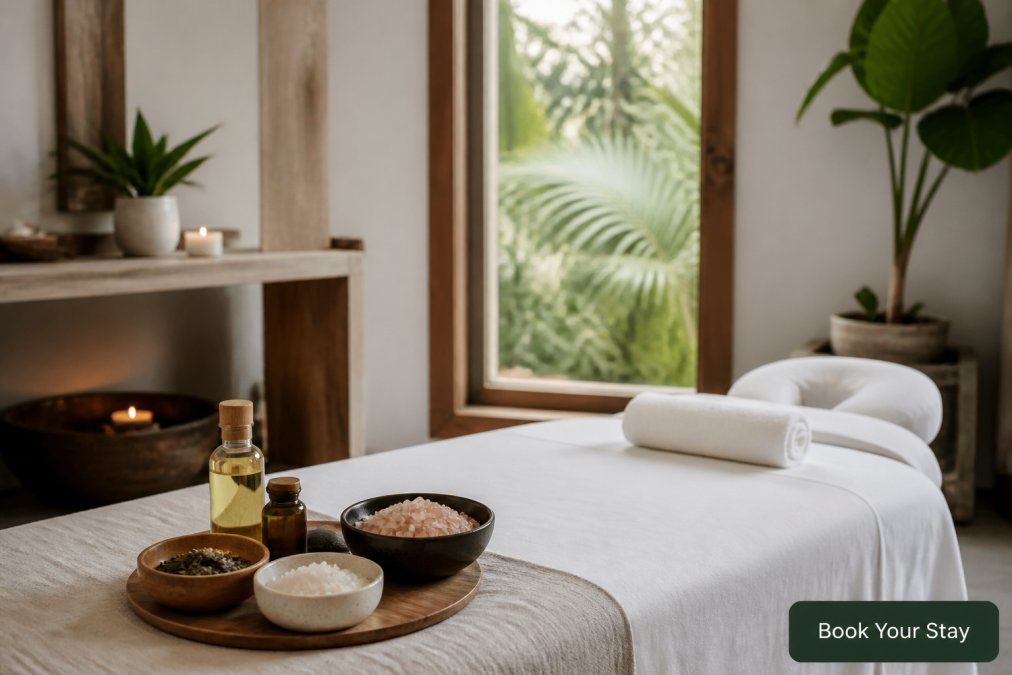
Thermal immersion and hydrotherapy use heat, steam and water to shift circulation and settle the nervous system. Sauna and steam sessions encourage vasodilation and sweating, and many guests find the post-sauna window is when their mind goes quietest. The effect is cumulative: by the third or fourth session, the body starts anticipating the drop rather than resisting it.
Signature Treatments That Address Deep Tension
Deep tension does not live in the surface muscles, so light relaxation massage rarely touches it. A sanctuary programme stacks several modalities across the stay. The signature treatments in the 5-night Stress Release Retreat include: These combined therapies create the necessary stillness for the nervous system to recalibrate, fostering a transition toward intentional slow living that extends well beyond the sanctuary walls.
- Ayurveda salt treatment for skin and lymphatic health
- Whole body remedial massage to address physical tension
- Detox herbal Moxa therapy and Chakra Healing therapy
- Detox body scrub and mud in steam capsules
- Hot stone massage and organic facial
Each one targets a different layer, from circulation and lymph to muscular holding and skin. You can view the full 5-night Stress Release Retreat package to see how they are sequenced across the stay.
What a 5 Night Wellness Retreat Itinerary Looks Like
A 5 night wellness retreat itinerary usually follows a deliberate arc: decompression, deep treatment, integration. The first day is deliberately empty. The middle days carry the heaviest therapeutic load. The final day is for consolidating, not squeezing in one last session.
Day-by-Day Rhythm of Rest and Restoration
| Phase | Days | Focus | Typical Sessions |
|---|---|---|---|
| Decompression | Day 1 | Arrival, sleep, silence | Gentle steam, early night |
| Deep treatment | Days 2-3 | Bodywork and detox | Remedial massage, Moxa, salt treatment |
| Reset | Day 4 | Nervous system | Hot stone, Chakra Healing, mud and steam |
| Integration | Day 5 | Consolidation | Organic facial, quiet reflection, departure plan |
The rhythm is not rigid. A bespoke programme flexes around how you actually respond, which is easier with two guests than twenty.
How to Vet a Private Wellness Sanctuary for Privacy and Security
Vetting a private wellness sanctuary comes down to three things: who else is on site, what happens to your information, and what the venue will do if you need help. Exclusivity claims are easy to make and easy to check, which is why most retreat content avoids asking venues to be specific.
Questions to Ask Before Booking
- How many guests are on site during my stay, and will I share any facility?
- Are treatment rooms private, and is the practitioner the same person throughout?
- Who has access to my booking details, health information and dietary requirements?
- What is the cancellation and medical-emergency policy?
- Is there a phone-free or device-free policy, and how is it enforced?
- Can I see a sample itinerary before I commit?
If a venue hedges on the first question, that is your answer.
What a Good Answer Looks Like
A checklist is only useful if you know how to read the response. Here is what separates a genuinely private venue from one that simply uses the word.
Guest numbers. A good answer is a specific figure tied to your dates, not a range. “We cap at two to three guests” is verifiable; “we keep it intimate” is not. Ask whether the figure includes day visitors, contractors or non-treatment staff.
Facility sharing. Ask which spaces are exclusively yours for the duration. A private room is not a private facility; if the sauna, steam room or pool is shared, the privacy claim is weaker than it sounds.
Practitioner continuity. Seeing the same practitioner across the stay matters for privacy and outcomes. A rotating team means repeating your history and preferences at every session, its own form of load.
Information handling. Your booking details, health information and dietary requirements are sensitive. Ask who can see them, whether they are stored digitally, and whether they are shared with any third party. A venue that cannot answer clearly is a risk, particularly for anyone in a public-facing role.
Emergency and medical policy. Privacy should never mean isolation in a crisis. Ask what happens if you become unwell, how far the nearest medical facility is, and whether staff hold current first aid qualifications.
Device and discretion policy. If you need to be unreachable, ask how the venue supports that. Some hold devices at arrival; others ask guests to keep them in rooms. The policy matters less than whether it is enforced consistently.
Red Flags Worth Walking Away From
A few patterns should end the conversation: vague answers to the guest-number question, a refusal to put exclusivity terms in writing, staff who cannot explain how your health information is stored, no clear emergency procedure, and any venue promising absolute secrecy without describing how it is maintained.
Exclusivity is a number, not an adjective. Ask how many guests are on site during your dates and get a specific figure in writing.
Why This Matters More Than the Brochure
Most retreat content focuses on amenities, views and treatment menus. For anyone whose work depends on discretion, the vetting questions above matter more than the thread count. A sanctuary that cannot demonstrate privacy in concrete terms is a sanctuary in name only, and the cost of getting it wrong is the loss of the very conditions you booked the stay to create.
If the answers hold up, the next step is to review the 5-night Stress Release Retreat package and confirm availability, or explore the full retreat packages to compare durations. Book Your Stay once you are satisfied on every point above.
Budgeting for Long-Term Wellness: The Real Return
Budgeting for long-term wellness is where most executives get the maths wrong. The comparison is not retreat versus holiday; it is retreat versus the cost of operating at reduced capacity for another year. A private sanctuary is a capital expenditure on the asset that generates every other return: your judgement, sleep and health.
Pricing depends on the programme, duration and level of customisation, so it is worth requesting a quote rather than assuming a figure. The honest test is what you would otherwise spend on the problem: the disrupted sleep, the short temper in meetings, the decisions made at 40 per cent capacity. Beyond Blue’s resources on stress and burnout set out the personal cost clearly, and it is rarely small.
Two things make the investment stick. First, a longer stay: five or six nights gives the nervous system time to actually change state. Second, a re-entry plan covering your first week back, sleep boundaries and the one or two habits you are keeping. A retreat without one is an expensive week off.
Safe Work Australia’s guidance on work-related psychological health is a useful reference point for how seriously sustained workplace stress is now treated, and it makes the case for acting before you are forced to.
The hard part is not finding a beautiful place to rest. It is admitting that a weekend off has stopped working, and choosing something with enough depth to change the pattern. Harmony Hill Health Retreat was built for that decision: a bespoke 6-day Thermal Therapy Retreat with only two to three guests per week, and a 5-night Stress Release Retreat built around Ayurveda salt treatment, whole body remedial massage, Detox herbal Moxa therapy, Chakra Healing therapy (hot stone massage and organic facial), and detox body scrub and mud in steam capsules. Book Your Stay and give your body the conditions it needs to reset properly.
Frequently Asked Questions
Are private health retreats worth the investment for high-pressure professionals?
For executives experiencing burnout, a private wellness sanctuary delivers focused, uninterrupted recovery that group settings cannot match. The absence of other guests means every session, meal and rest period is tailored to your needs. This intensity compresses weeks of scattered self-care into a few days, making the investment a targeted intervention rather than a passive holiday.
What distinguishes a private wellness sanctuary from a standard spa resort?
A private wellness sanctuary limits guest numbers to preserve seclusion and personal attention. Standard spa resorts operate at scale, with shared facilities and fixed schedules. A sanctuary typically offers bespoke programmes, one-on-one therapeutic sessions and a level of privacy that allows deep decompression. The focus shifts from amenities to outcomes like cortisol reduction, emotional reset and sustained vitality.
What specific holistic therapies are included in a premium wellness sanctuary stay?
Premium programmes often combine thermal immersion, hydrotherapy and hands-on treatments. A five-night stress release retreat may feature Ayurveda salt treatment, whole body remedial massage, detox herbal Moxa therapy, Chakra Healing therapy (hot stone massage and organic facial), and detox body scrub and mud in steam capsules. These therapies work together to calm the nervous system and support detoxification.
Why is seclusion a critical factor in effective burnout recovery?
Burnout recovery requires the nervous system to exit constant alert mode. Shared environments, even pleasant ones, keep the brain scanning for social cues and obligations. Seclusion removes that load entirely. With only two or three guests, a private wellness sanctuary creates the conditions for genuine mental clarity, restorative sleep and the kind of deep rest that rebuilds resilience.
How does a 5 night wellness retreat itinerary support long-term stress recovery?
A five-night itinerary allows enough time for the body to move past initial relaxation into deeper restoration. The first days focus on decompression and sleep, while later days introduce therapeutic treatments and personalised guidance. This arc helps guests build practical tools they can carry home, improving the odds that the benefits last beyond the retreat itself.