
Table of Contents
- What Executive Wellness Retreats Actually Are
- Why Corporate Burnout Recovery Demands More Than a Holiday
- The Thermal Therapy Benefits for Stressed Leaders
- The Six-Day Reset: What Happens Inside a Structured Retreat
- Mindfulness, Sleep Optimisation, and Mental Clarity
- Post-Retreat Integration: Making the Reset Stick
- Solo Retreat Dynamics and Privacy for Executives
- Conclusion
Last Updated: August 25, 2026
What Executive Wellness Retreats Actually Are
Executive wellness retreats are intensive, multi-day programmes designed specifically for high-pressure corporate leaders to reset their nervous systems and recover from chronic burnout. Unlike a standard holiday or spa weekend, these retreats combine structured therapeutic modalities, mindfulness training, and personalised coaching within a contained environment, typically ranging from three to seven days, where participants are removed entirely from their usual work demands.
The core philosophy centres on what might be called “active restoration.” Rather than simply resting, executives engage in guided practices that address the root causes of burnout: accumulated stress, sleep disruption, weakened immunity, and the inability to mentally disengage from survival-mode thinking. Harmony Hill Health Retreat, for instance, specialises in a six-day Thermal Therapy Retreat model that welcomes only two to three guests per week, creating an intimate setting where deep mind-body detoxification and spiritual alignment become possible.
What distinguishes executive wellness retreats from other wellness offerings is their intensity and specificity. A weekend spa trip addresses surface tension. An executive wellness retreat addresses the nervous system’s chronic dysregulation, the physiological patterns that keep high-performing leaders locked in a state of perpetual alertness even when they’re supposed to be resting.
Why Corporate Burnout Recovery Demands More Than a Holiday
Corporate burnout isn’t simply fatigue. It’s a state in which the body’s stress-response system has been locked in the “on” position for so long that the executive’s baseline has shifted. They’ve normalised a level of cortisol and adrenaline that would alarm most people. A traditional holiday, even a good one, doesn’t reset this baseline. The executive returns to the office and within days, sometimes hours, slips back into the same neurological patterns.
This is where the difference between a retreat and a holiday becomes critical. A holiday offers distraction. A retreat offers intervention. Corporate burnout recovery requires what might be called “nervous system retraining”, a deliberate, structured process in which the body learns to access rest states it may have forgotten how to access naturally.
Many leaders have tried meditation apps, wellness programmes at work, or even shorter spa breaks. These have their place, but they operate at the surface level. They don’t address the deeper issue: the executive’s physiology has adapted to crisis mode. Their sleep architecture is fragmented. Their immune response is compromised. Their ability to make decisions from a place of clarity rather than survival instinct has eroded.
A structured executive wellness retreat creates the conditions for genuine nervous system reset. The environment is controlled. The schedule is intentional. There are no emails, no meetings, no decisions to make. The retreat’s therapeutic team guides the executive through modalities, thermal therapy, mindfulness, functional medicine integration, narrative therapy, that work together to deactivate the chronic stress response and restore the body’s capacity for genuine rest and recovery. For those seeking comprehensive detoxification alongside stress relief, programmes like the 5-Night Stress Release Retreat are designed to address both the physiological and psychological dimensions of burnout in an integrated way.
The Thermal Therapy Benefits for Stressed Leaders
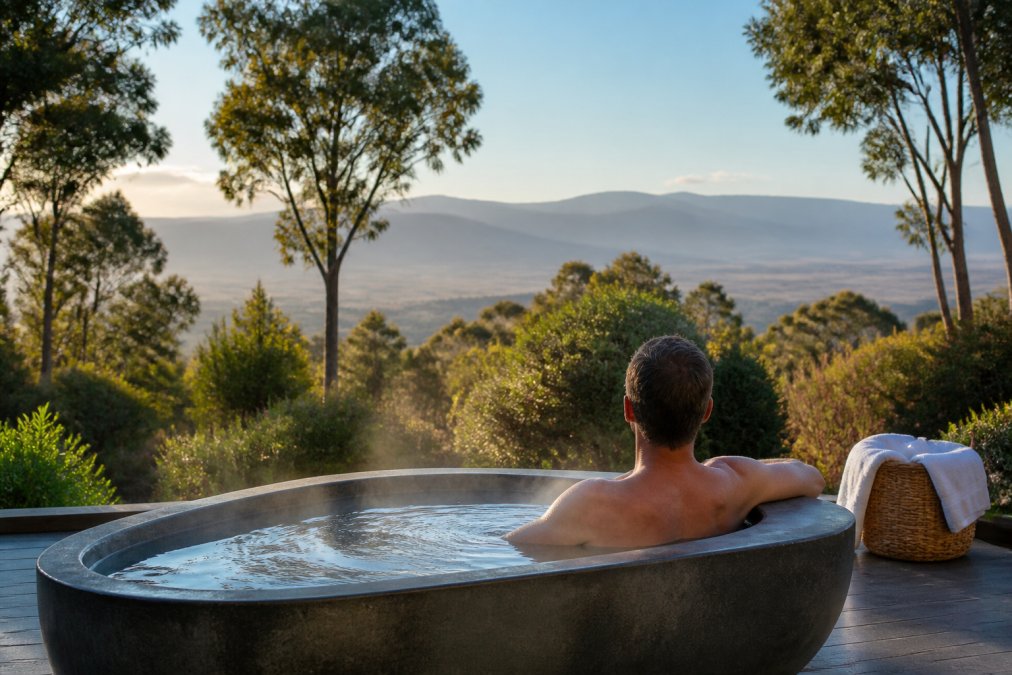
Thermal therapy, the therapeutic use of heat and water, operates on a principle that ancient cultures understood well: heat creates physiological change. When a stressed executive’s body is immersed in warm water, several measurable shifts occur. Blood vessels dilate. Muscle tension releases. The nervous system begins to shift from sympathetic dominance (the “fight or flight” state) toward parasympathetic activation (the “rest and digest” state) (peer-reviewed research).

For leaders carrying months or years of accumulated tension, thermal therapy offers something that stretching or massage alone cannot: a full-body signal that safety is available. The warm water doesn’t just relax muscles; it communicates to the nervous system that the threat state can be lowered. Regular thermal immersion during a retreat helps reset the body’s baseline temperature regulation, improves circulation, and supports what’s sometimes called “cellular detox”, the process by which the body’s natural elimination systems function more efficiently when stress hormones are lowered.
The benefits extend beyond the immediate session. Leaders who engage in thermal therapy report improved sleep quality, reduced muscle tension, and a noticeable shift in their capacity to think clearly. This isn’t mystical; it’s neurophysiology. When the body is no longer in a chronic stress state, cognitive function improves, emotional regulation becomes easier, and decision-making clarity returns.
Harmony Hill Health Retreat integrates thermal therapy as a cornerstone of its six-day model, recognising that this modality addresses one of burnout’s most stubborn symptoms: the body’s inability to fully relax even when the mind knows rest is available.
The Six-Day Reset: What Happens Inside a Structured Retreat
A six-day executive wellness retreat follows a carefully designed arc. The first two days focus on arrival and initial nervous system downregulation. The executive’s schedule is light. They’re introduced to the retreat’s environment, philosophy, and therapeutic team. Thermal therapy sessions begin. Sleep is prioritised. The goal is to lower the nervous system’s activation level enough that deeper work becomes possible.
Days three and four are the intensive core. This is where structured therapeutic work intensifies. Mindfulness and meditation sessions deepen. Personalised coaching sessions address specific patterns, the executive’s relationship with control, perfectionism, or the inability to delegate. Functional medicine consultations may explore how nutrition, sleep architecture, and stress hormones interact. Narrative therapy sessions invite the executive to examine the stories they tell themselves about their role, their value, and what rest actually means.
Days five and six shift toward integration and preparation for re-entry. The retreat’s focus moves toward post-retreat strategies: how to maintain the nervous system changes achieved during the intensive days, how to protect new patterns from being overwritten by old workplace demands, how to communicate boundaries that will sustain the reset.
Throughout all six days, the exclusivity of the setting, only two to three guests, means the therapeutic team can tailor every element to the individual executive’s needs. There’s no standardised programme where everyone does the same thing at the same time. Instead, thermal therapy sessions, coaching conversations, and mindfulness practices are personalised based on what each leader’s nervous system and psyche actually need.
Mindfulness, Sleep Optimisation, and Mental Clarity
Mindfulness training in an executive wellness retreat context differs markedly from a meditation app. It’s not a brief daily practice squeezed between meetings. It’s an immersive retraining of attention itself. Over six days, an executive’s capacity to sustain focus without the constant pull of urgency can be restored. They learn to distinguish between genuine priority and the false urgency that burnout creates.
But what makes this transformation measurable? Sleep optimisation is equally deliberate and, crucially, quantifiable. Many burnt-out executives have fragmented sleep architecture, their minds remain partially alert even at night, cycling through light sleep and micro-awakenings (peer-reviewed research). A retreat addresses this through multiple vectors: thermal therapy relaxes the body, mindfulness training quiets the mind’s threat-scanning, functional medicine may address nutritional or hormonal factors disrupting sleep, and the simple absence of work demands allows the body’s natural sleep architecture to restore.
Unlike generic wellness claims, sleep quality can be tracked objectively. Executives often arrive at a retreat sleeping five to six hours nightly with poor sleep efficiency (the percentage of time in bed actually spent asleep). By day four or five, many report sleeping seven to eight hours with significantly improved continuity. This isn’t subjective feeling; it’s a measurable shift in sleep architecture that reflects genuine nervous system recovery. integrated wellness strategies.
The cognitive gains follow directly from this physiological reset. When the nervous system is no longer in crisis mode, decision-making becomes less reactive and more strategic. Creative problem-solving returns. The executive can think in longer time horizons rather than moment-to-moment survival mode. This clarity isn’t temporary; when properly integrated post-retreat through ongoing practices and boundary-setting, it becomes a sustainable new baseline.
Harmony Hill Health Retreat tracks these shifts through pre- and post-retreat assessment, helping executives see the concrete changes in their sleep patterns, stress markers, and mental clarity. This data-driven approach is what distinguishes a genuine wellness intervention from a luxury escape, it provides the evidence executives need to justify the investment to themselves and their organisations, and it creates accountability for maintaining the gains once they return to their high-pressure roles.
Post-Retreat Integration: Making the Reset Stick
This is where most wellness interventions fail. An executive leaves a retreat feeling transformed, returns to their office on day seven, and by day fourteen, the old patterns have reasserted themselves. The nervous system slips back into its familiar dysregulated state. The reset doesn’t stick.

Structured post-retreat integration is what separates a temporary experience from a lasting transformation. This typically involves several components. First, a clear post-retreat protocol: specific practices the executive commits to daily or weekly, thermal baths at home, continued mindfulness, regular movement, sleep hygiene discipline. Second, ongoing coaching or check-in support, often monthly, to help the executive navigate the inevitable pressures that arise and prevent old patterns from reasserting.
Third, and most importantly, boundary-setting around work itself. The reset achieved in a retreat is fragile if the executive returns to the same schedule, the same expectations, and the same inability to say no. Integration requires honest conversation about what work patterns created the burnout in the first place and what structural changes, delegation, reduced meeting load, clearer off-hours boundaries, are necessary to sustain the reset.
Many executives find that the clarity achieved during a retreat makes these conversations easier. They can see, with new perspective, which commitments are genuinely necessary and which are habits of perfectionism or control. They can negotiate differently with their organisation because they’ve experienced what genuine health feels like and are no longer willing to trade it away.
Solo Retreat Dynamics and Privacy for Executives
One of the most distinctive features of executive wellness retreats designed for senior leaders is the emphasis on privacy and confidentiality, but this choice involves real trade-offs that executives should understand before committing.
A solo or near-solo retreat (two to three guests maximum) offers several concrete advantages. First, therapeutic depth: without group dynamics to navigate, an executive can focus entirely on their own nervous system reset and personal exploration. There’s no performative element, no need to maintain a professional persona even in a wellness setting. A CEO can speak openly with their coach about their fears, their relationship with power, their doubts about their leadership, knowing that vulnerability won’t become office gossip. This confidentiality isn’t merely luxurious; it’s clinically necessary. Research in therapeutic settings consistently shows that privacy and confidentiality are prerequisites for genuine disclosure and transformation (peer-reviewed research).
Second, personalisation: with only two or three guests, the retreat’s therapeutic team can tailor every element, thermal therapy sessions, coaching conversations, mindfulness practices, meal timing, even the pace of the programme, to each individual’s needs. A group retreat, by contrast, requires compromise. Everyone meditates at 6 a.m., everyone does thermal therapy at 2 p.m., everyone attends the same coaching session. For executives with complex, individualised burnout patterns, this one-size-fits-most approach often fails to address their specific nervous system dysregulation.
Third, confidentiality protection: a senior leader cannot afford to have their retreat attendance become known in their industry or organisation. The intimate setting of a solo or near-solo retreat ensures that no peer, competitor, or colleague is present. The therapeutic relationship between the executive and the retreat’s coaching and clinical team is professionally boundaried and deeply confidential, governed by the same ethical standards as clinical psychology or counselling.
However, solo retreats are not universally optimal. Some executives benefit from the normalisation that comes from knowing other high-performing leaders are struggling with similar patterns. A cohort-based retreat, where four to eight carefully selected executives attend together, can provide peer support, reduce shame, and create accountability partnerships that extend post-retreat. The trade-off is reduced privacy and less individualised attention.
Harmony Hill Health Retreat‘s model, limiting guests to two or three per week, represents a deliberate middle ground. It preserves confidentiality and therapeutic depth while occasionally allowing an executive to know they’re not alone in their struggle. The choice between solo and group formats ultimately depends on the executive’s personality, their industry’s gossip networks, and whether they’re seeking primarily clinical intervention or also peer connection. Both approaches can be effective; the key is matching the format to the individual’s actual needs and risk tolerance.
Conclusion
Burnout in high-pressure leadership roles isn’t solved by a long weekend away or a meditation app. It requires a structured intervention that addresses the nervous system’s chronic dysregulation at its root. An executive wellness retreat, particularly one designed specifically for the demands of senior leadership, creates the conditions for genuine reset: a contained environment, therapeutic modalities proven to shift nervous system state, personalised coaching, and the privacy executives need to be fully honest about their struggle.
Harmony Hill Health Retreat’s six-day Thermal Therapy Retreat model embodies this approach, combining thermal therapy, mindfulness training, functional medicine integration, and personalised coaching within an intimate setting designed for profound transformation. The retreat’s philosophy, rooted in ancient wisdom and modern therapeutic practice, guides executives away from survival-mode living toward sustainable high performance and genuine peace.
If you’re experiencing the weight of chronic burnout and recognise that standard wellness offerings haven’t moved the needle, explore what Harmony Hill Health Retreat offers. Enquire about availability for a six-day reset designed specifically for leaders ready to reclaim their vitality and mental clarity. Visit organicspa-retreat.com to learn more about the Thermal Therapy Retreat and other specialised programmes tailored to your needs.
Frequently Asked Questions
How do executive wellness retreats actually help with burnout recovery?
Executive wellness retreats address burnout at multiple levels: they interrupt the stress cycle through physical detoxification, restore sleep patterns disrupted by chronic pressure, and provide psychological space for reflection and emotional reset. A structured 6-day retreat removes you from triggering environments, allowing your nervous system to downregulate. Unlike weekend spa trips or meditation apps, intensive retreats combine thermal therapy, mindfulness training, personalised nutrition, and one-on-one coaching to create lasting shifts in how your body and mind respond to high-pressure work.
What makes a bespoke executive wellness retreat different from a standard wellness holiday?
A bespoke retreat is clinically designed for your specific stress profile and leadership challenges, not a generic itinerary applied to everyone. It includes personalised assessments, tailored thermal therapy sessions, one-on-one wellness coaching focused on your role, and strategic reflection time. Standard holidays offer relaxation but don't address the physiological drivers of executive burnout—cortisol elevation, sleep debt, cognitive fatigue, and immune suppression. Bespoke retreats integrate functional medicine, behavioural psychology, and resilience-building frameworks to produce measurable shifts in stress markers and sustained performance gains.
Are private wellness retreats effective for long-term stress management after I return to work?
The effectiveness depends on post-retreat integration. A retreat alone creates a temporary reset; the real transformation happens when you apply new practices to your daily life. The best retreats include a structured integration plan: follow-up coaching calls, specific stress-management protocols for your workplace, sleep and nutrition guidelines you can maintain, and mindfulness practices you can sustain. Many executives report that the clarity and resilience gained during the retreat fundamentally shift how they approach high-pressure situations months later—but only if they commit to the post-retreat framework.
What should high-pressure leaders look for in a wellness retreat?
Prioritise confidentiality and exclusivity—you need a private space where you can be vulnerable without professional risk. Look for a retreat that combines thermal therapy or other proven physiological interventions with psychological support, not just meditation. Verify that the retreat offers personalised assessment and coaching, not a one-size-fits-all schedule. Check whether they provide post-retreat integration support and measurable outcomes tracking. Finally, choose a retreat grounded in both ancient wisdom and modern clinical understanding—one that explains the science behind its practices and can articulate why their approach works for executive-level stress.