

Table of Contents
- The Cost of Neglecting Executive Well-being
- Why Traditional Wellness Retreats Fail Busy Leaders
- How Long Should a Wellness Retreat Be for Real Results
- Executive Burnout Recovery Strategies That Actually Work
- Customisation vs Off-the-Shelf Packages: What Leaders Actually Need
- Measuring ROI: How to Know Your Retreat Investment Paid Off
- Conclusion
Last Updated: August 12, 2026
The Cost of Neglecting Executive Well-being
Burnout among high-pressure leaders isn’t a productivity problem, it’s a systemic one. When executives operate in survival mode, their decision-making deteriorates, their teams lose direction, and the entire organisation suffers cascading effects. Chronic stress rewires the nervous system into constant threat detection, making leaders reactive rather than strategic, defensive rather than creative. At Harmony Hill Health Retreat, we’ve observed that executives who ignore these warning signs face compounding consequences: relationships deteriorate, health markers decline, and authentic leadership erodes. Yet most organisations treat executive wellness as an afterthought rather than a strategic investment. The irony is that preventing burnout costs exponentially less than recovering from it.

Executive burnout isn’t a personal failing, it’s a systemic breakdown that affects entire organisations. The cost of ignoring it far exceeds the investment required to address it properly.
Why Traditional Wellness Retreats Fail Busy Leaders
Most wellness retreats fail because they treat burnout as a symptom to manage rather than a systemic pattern to interrupt. A weekend spa package or meditation app provides temporary relief but doesn’t address the nervous system dysregulation that keeps leaders locked in high-alert mode.
The Re-entry Shock Phenomenon
The moment a leader returns to the office after a retreat, old patterns reassert themselves with brutal efficiency. Email floods back in, meetings resume their relentless pace, and the calm clarity achieved during those few days dissolves within hours. This happens because the retreat addressed symptoms without establishing the neural pathways required to sustain change. Many executives report feeling worse after a retreat than before, having tasted genuine peace only to have it ripped away. Without post-retreat integration strategies, deliberate practices that anchor shifts into daily life, the experience becomes demoralising rather than transformative. The real work isn’t what happens during the retreat; it’s what happens in the weeks after, when the executive must actively defend new patterns against the gravitational pull of old habits.
Insufficient Nervous System Regulation Training
Generic wellness programs teach relaxation techniques but rarely address the root cause: a nervous system stuck in chronic vigilance. High-performing leaders have spent decades training their nervous systems to operate in overdrive. A few breathing exercises won’t recalibrate that. Effective nervous system regulation requires understanding the specific patterns triggering dysregulation for each individual. Without personalisation, retreat programming becomes one-size-fits-all advice that rarely sticks. Leaders learn the theory but can’t translate it into their specific context.
Leadership Disconnect in Wellness Design
Most retreat designers have never worked in high-pressure executive roles. They design programs based on assumptions rather than lived experience. A leader might spend the day in wellness activities, then return to their room working through crisis emails because the retreat didn’t address the psychological barriers preventing genuine disconnection. Effective wellness design requires understanding the specific cognitive and emotional patterns keeping leaders trapped in high-alert mode.
How Long Should a Wellness Retreat Be for Real Results
The optimal retreat duration for lasting change is typically six to eight days. A single day won’t create lasting neural change; a weekend might provide temporary relief but insufficient time for genuine recalibration. Six days allows the nervous system to begin genuinely downregulating and for new patterns to take root.
Nervous system regulation isn’t linear. Day one finds most executives in acute stress. Days two and three involve increased anxiety as the body releases stored tension. By day four or five, genuine calm emerges. Days six through eight allow integration of these shifts and the beginning of new neural patterning. Shorter retreats often conclude just as real transformation begins, leaving participants convinced retreat work doesn’t work. Longer retreats can create dependency rather than autonomy.
The sweet spot isn’t about duration alone, it’s about having enough time for nervous system downregulation (typically 4-5 days) plus integration time (1-2 days) where participants begin practising new patterns within [the retreat](/executive-mental-health-retreat-tasmania-booking-1/) environment before returning home.
Executive Burnout Recovery Strategies That Actually Work
Recovery from burnout requires deliberate interruption of entrenched patterns. Effective recovery begins with honest assessment, recognising that current patterns are unsustainable and that genuine change requires deliberate intervention, not just better time management. Recovery strategies typically involve three components: nervous system recalibration (teaching the body how to genuinely rest), cognitive reframing (examining beliefs driving unsustainable patterns), and behavioural restructuring (establishing new daily practices supporting sustained wellbeing).
Post-Retreat Integration and Accountability
The retreat itself is merely the catalyst. What happens after determines whether the experience creates lasting change or becomes a pleasant memory. Effective integration involves three elements: understanding the specific patterns discovered during the retreat, concrete daily practices anchoring those patterns into ordinary life, and accountability structures maintaining momentum when motivation wanes.
Many leaders fail at integration by trying to maintain retreat-level practices in non-retreat environments. Instead, integration focuses on identifying minimal viable practices, the smallest shifts creating meaningful change, and protecting those fiercely. This might mean a fifteen-minute morning practice rather than an hour-long routine, but if it’s sustainable and genuinely protective, it’s infinitely more valuable. Accountability matters because the nervous system naturally reverts to familiar patterns under stress.
Psychological Safety and Vulnerability
Genuine recovery requires vulnerability, which most high-performing leaders actively resist. Yet this resistance keeps them locked in unsustainable patterns. Effective retreats create psychological safety, an environment where vulnerability becomes the pathway to authentic change. This means small group sizes, skilled facilitation that models vulnerability, and explicit permission to step outside the professional persona. Without psychological safety, leaders perform wellness rather than experiencing it.
Customisation vs Off-the-Shelf Packages: What Leaders Actually Need
Generic wellness programs fail because they assume all executives experience burnout identically. One leader might be overwhelmed by complexity; another by relational conflict; a third by perfectionism. Off-the-shelf packages offer convenience but rarely address specific nervous system patterns or psychological structures keeping individual leaders stuck.
Customised retreats require assessment before the retreat begins, understanding the leader’s specific stress signature and unique barriers to change. The program is then tailored: specific nervous system interventions, psychological work, daily schedule, and physical environment adjusted to match what this particular leader needs. The trade-off is complexity and cost, but customised retreats are exponentially more likely to create lasting change.
| Approach | Best For | Key Limitation | Integration Support |
|---|---|---|---|
| Off-the-shelf packages | Leaders with similar needs, budget-conscious organisations | Generic programming, limited personalisation | Often minimal or absent |
| Customised retreats | Executives with complex burnout patterns, serious dysfunction | Higher cost, requires skilled assessment | Typically comprehensive and ongoing |
Measuring ROI: How to Know Your Retreat Investment Paid Off
Most organisations struggle to measure retreat ROI because they focus on the wrong metrics. Satisfaction scores and subjective feelings don’t indicate lasting change. Meaningful ROI measurement requires assessing whether the retreat produced measurable shifts in specific areas where the leader was struggling: cognitive clarity, decision-making speed, sleep quality, relationship health, and strategic versus reactive choices.
The most reliable ROI indicators emerge over three to six months post-retreat, not immediately. Effective measurement involves baseline assessment before the retreat, measurement immediately post-retreat, and follow-up assessment at three and six months. This reveals whether the retreat created temporary relief or genuine transformation.
Measuring retreat ROI immediately after completion is misleading. The real test is whether changes persist and deepen over the following three to six months. Early satisfaction often doesn’t correlate with lasting impact.
Wellness retreats fail busy leaders not because the concept is flawed but because most programs misunderstand what genuine recovery requires. It’s not about luxury spa treatments or a few days away from stress. It’s about deliberate nervous system recalibration, authentic psychological work, and sustained integration anchoring change into daily life.
The difference between a retreat creating lasting transformation and one providing temporary relief comes down to three factors: whether the program addresses specific nervous system patterns driving burnout rather than generic stress, whether it builds genuine psychological safety allowing vulnerability and authentic change, and whether it includes rigorous post-retreat integration sustaining momentum.
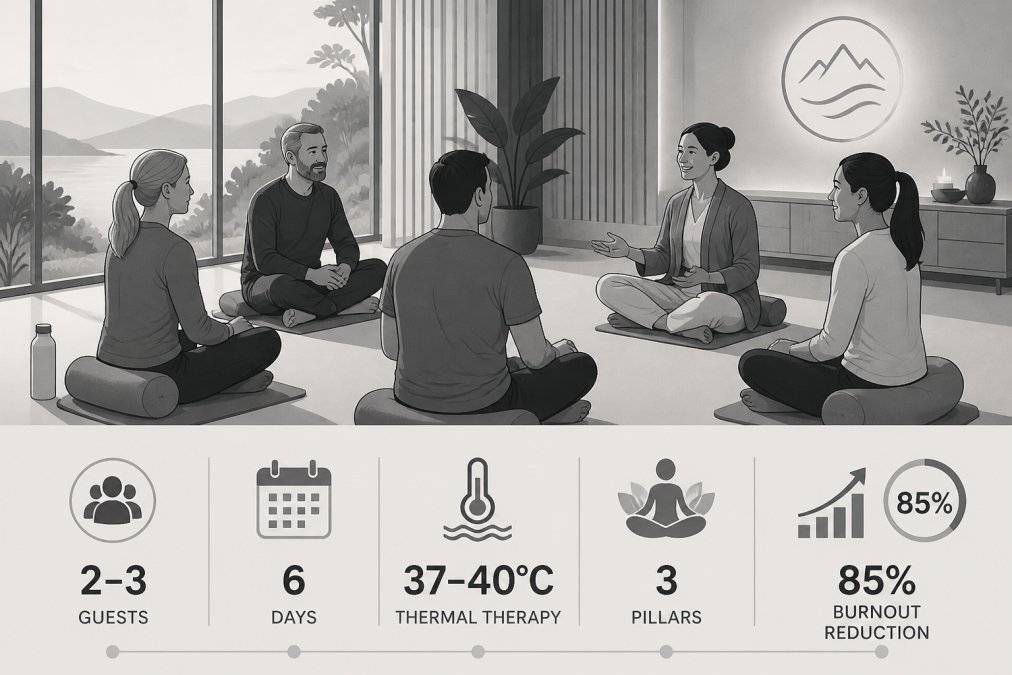
At Harmony Hill Health Retreat, the 6-day Thermal Therapy Retreat is designed specifically for this depth of work. By limiting participation to two or three guests per week and tailoring the entire program to each leader’s specific burnout signature, it addresses root causes rather than symptoms. The focus on nervous system regulation through ancient thermal therapies combined with modern psychological work creates conditions for genuine recovery. Most importantly, the integration framework extending beyond the retreat ensures shifts achieved during those six days become the foundation for sustained wellbeing. Research on executive wellness interventions indicates that personalised, intensive programs deliver measurable improvements in leadership performance and wellbeing. The leaders who experience genuine transformation aren’t seeking the cheapest option or shortest timeframe, they’re committed to addressing the actual problem.
Frequently Asked Questions
Why do wellness retreats often fail to provide long-term burnout relief?
Most wellness retreats fail because they lack post-retreat integration strategies. Leaders experience temporary relief during the retreat, then return to the same high-pressure environment without tools to sustain change. The re-entry shock is real: cognitive load returns, nervous system dysregulation resumes, and old patterns reassert themselves within days. Retreats that succeed include accountability structures, ongoing coaching, and concrete strategies for maintaining nervous system regulation in the workplace. Without these elements, even transformative experiences fade quickly.
How long should a wellness retreat be to create lasting change?
A minimum of 5-6 days is necessary for meaningful nervous system regulation and cellular detoxification. Shorter retreats (weekends or 2-3 days) provide temporary relief but insufficient time for the body's stress response to genuinely reset. A 6-day intensive allows deep work in mind-body integration, enables psychological safety to develop, and gives leaders space to process the systemic stress they carry. However, duration alone doesn't guarantee results, what matters most is what happens after the retreat ends and how well the experience is integrated into daily work life.
What are the key barriers to engagement that prevent wellness retreats from working for busy executives?
Busy leaders face several barriers: fear of being away from the office and losing control, scepticism about 'wellness marketing,' concern that one retreat won't address systemic workplace stress, and worry that colleagues won't respect their time away. Many also struggle with vulnerability in group settings and doubt whether the investment justifies the cost. The biggest barrier is leadership disconnect, retreats designed by wellness professionals rather than people who understand high-pressure executive roles often miss the real pain points. Effective retreats address these barriers directly through exclusivity, bespoke customisation, and transparent ROI frameworks.
How can leaders measure whether their wellness retreat investment actually paid off?
Measure three concrete metrics: sleep quality and duration (use a sleep tracker for 30 days post-retreat), productivity and cognitive clarity (track focus time and decision-making speed), and stress biomarkers like resting heart rate and cortisol levels if available. Beyond metrics, notice behavioural changes: are you setting boundaries differently? Are you managing cognitive load better? Can you access calm under pressure? The real ROI appears 60-90 days post-retreat when old patterns would normally reassert themselves. If you're still maintaining nervous system regulation and sustainable performance without returning to survival mode, the retreat worked.
This article was written using GrandRanker