
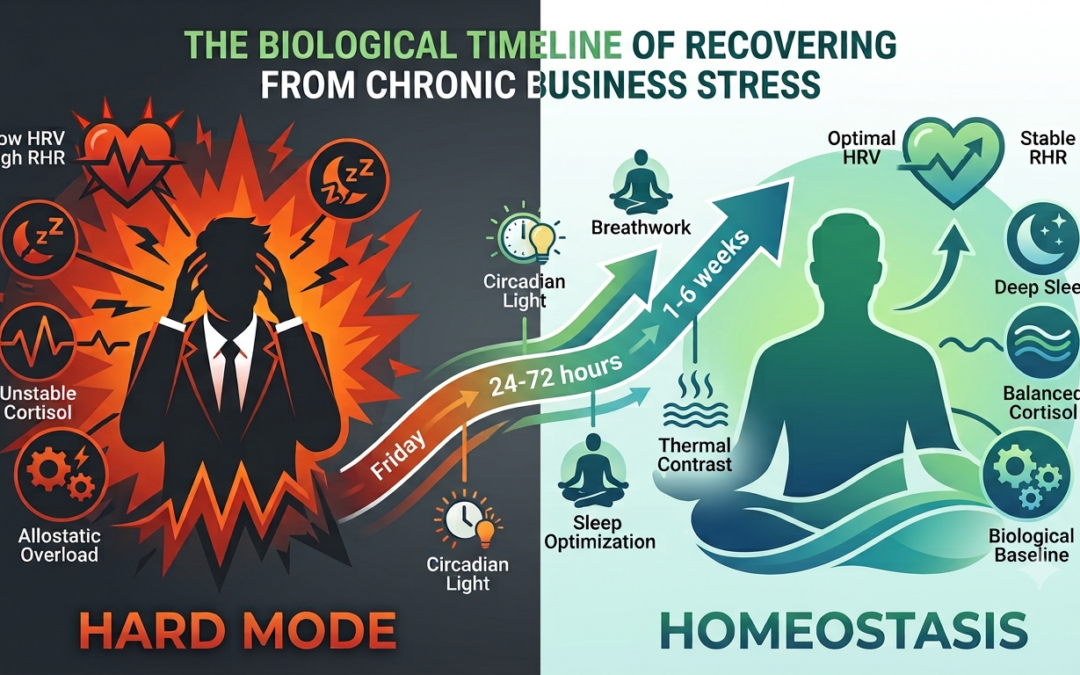
If you’ve spent months (or years) operating in a high-output, high-stakes business environment, you already know the feeling: alert but exhausted, wired but foggy, “on” even when you’re trying to be off. This isn’t a mindset problem. It’s a measurable, physiological state — and it has a name in stress biology: allostatic overload, colloquially, “Hard Mode.”
The good news is that homeostasis — the body’s baseline of biological stability — isn’t lost forever. It’s recoverable, and recent advances in autonomic and endocrine research let us actually track that recovery, hour by hour and day by day, using the same biomarkers biohackers already monitor: heart rate variability (HRV), resting heart rate (RHR), cortisol slope, and sleep architecture.
This article breaks down the biology of chronic business stress, what “Hard Mode” actually looks like inside your nervous system and endocrine system, and gives you a realistic, evidence-informed timeline for how your body transitions back to homeostasis when you finally give it the right conditions.
What “Homeostasis” Actually Means (And Why Hard Mode Isn’t Just a Feeling)
Homeostasis is your body’s default operating state: a dynamic equilibrium where your autonomic nervous system, endocrine axes, immune signaling, and sleep architecture all regulate each other within a healthy range. It’s not stillness — it’s responsive stability. Your heart rate rises and falls appropriately, cortisol follows a clean diurnal curve, and your parasympathetic (“rest-and-digest”) system is available on demand.
Chronic business stress — back-to-back deadlines, constant context-switching, travel, late-night emails, decision fatigue — doesn’t just feel unpleasant. It shifts your entire physiology into a sustained sympathetic-dominant state. Stress physiologist Bruce McEwen coined the term allostatic load to describe the cumulative biological wear this produces: the cost of chronically adapting to demand without adequate recovery.
Under sustained allostatic load, four systems get pulled out of their normal operating range:
- The HPA axis (hypothalamic-pituitary-adrenal axis) — the cortisol-releasing system — stays activated longer and recovers more slowly after each stressor.
- The autonomic nervous system shifts toward sympathetic dominance, suppressing vagal (parasympathetic) tone.
- Sleep architecture loses deep slow-wave and REM sleep, the stages responsible for physical and cognitive repair.
- Low-grade inflammatory signaling (via cytokines like IL-6) rises, a downstream effect of prolonged cortisol elevation and poor sleep.
This is “Hard Mode”: a body running a permanent low-grade emergency response while still expected to perform high-level cognitive and physical work.
Why You Can’t Think Your Way Out of Hard Mode
This is the part most driven professionals get wrong. Hard Mode is not a discipline failure, and it doesn’t resolve through willpower, positive thinking, or “pushing through.” It is a bottom-up physiological state, and it requires bottom-up physiological input to reverse — meaning your nervous system needs sensory and biochemical signals (not thoughts) that tell it the threat has passed.
This is exactly why biohackers gravitate toward measurable interventions: cold exposure, breathwork, heat exposure, circadian light management, and sleep optimization. These tools work because they directly modulate the vagus nerve, baroreceptors, and core temperature — the actual control levers of the autonomic nervous system — rather than relying on cognitive reappraisal alone.
The Four Biomarkers That Tell You Where You Really Are
If you want to track your transition from Hard Mode to homeostasis the way you’d track VO2 max or body composition, these four markers give you the clearest signal:
Heart Rate Variability (HRV) HRV reflects the balance between sympathetic and parasympathetic activity. Under chronic stress, HRV drops and becomes “flatter” — a hallmark of a nervous system stuck in threat-response mode. As parasympathetic tone returns, HRV rises and becomes more variable breath to breath.
Resting Heart Rate (RHR) A chronically elevated RHR (even by 3–8 bpm above your personal baseline) is a simple, direct readout of sympathetic dominance. This is often the first number to visibly shift during recovery.
Cortisol Slope Healthy cortisol follows a steep morning rise and a smooth decline through the day (the Cortisol Awakening Response, or CAR). Under chronic stress, this curve flattens — cortisol stays elevated into the evening and doesn’t peak properly in the morning, which is part of why stressed professionals feel “tired but wired” at night and groggy in the morning.
Sleep Architecture Wearables that estimate sleep stages will typically show reduced deep sleep and fragmented REM under chronic stress. Since deep sleep drives physical repair and REM drives cognitive/emotional processing, this is where the “I slept eight hours and still feel exhausted” experience comes from.
The Recovery Timeline: From Hard Mode to Homeostasis
Here’s where nuance matters, and where most wellness content oversimplifies. Recovery from stress happens on two different clocks, and understanding both is what separates a real reset from a temporary feeling of relief.
Clock 1 — The Autonomic Reset (24–72 hours). This is the fast system. Once you remove the acute stress inputs (notifications, decision-making, artificial light at night, alcohol, caffeine timing) and add strong parasympathetic signals (sleep, nature exposure, breathwork, thermal contrast, physical touch or massage), your autonomic nervous system can shift meaningfully within a single weekend. HRV and RHR are the first to respond, often within 24–48 hours of consistent recovery input.
Clock 2 — The Endocrine and Structural Reset (1–6 weeks). This is the slow system. Your cortisol rhythm, inflammatory markers, and deep sleep architecture take longer to fully normalize, because they reflect accumulated allostatic load, not just your current 24-hour state. A single weekend won’t fully reverse months of chronic overload — but it can meaningfully shift your trajectory and initiate the repair process that continues over subsequent weeks if you sustain the new inputs.
With that distinction in mind, here’s a realistic biological timeline for a dedicated recovery period, such as a long weekend away from work demands:
Friday, Late Afternoon — Exit From Hard Mode Begins The moment you remove the acute stressor (leaving the work environment, silencing notifications), sympathetic activation begins to taper. Cortisol is still likely elevated from the day’s demands, and HRV is still suppressed. This is the “coming down” period many people describe as restlessness or an inability to relax — a real physiological lag, not impatience.
Friday Night — First Parasympathetic Signal A full, uninterrupted sleep cycle in a low-stimulation environment is the single strongest lever available. Even one night of quality sleep begins to restore some REM density and reduce sympathetic tone, though sleep is often still fragmented this first night due to residual cortisol elevation.
Saturday Morning — Cortisol Awakening Response Starts Correcting With appropriate morning light exposure and without immediate digital demands, the CAR — that healthy morning cortisol spike — begins to sharpen. This is a critical signal because a properly timed cortisol spike in the morning is what allows cortisol to decline appropriately for the rest of the day.
Saturday Midday — Vagal Tone Rebuilding Activities that stimulate the vagus nerve — slow nasal breathing, cold water immersion, time in nature, massage, or sauna-to-cold contrast — produce measurable HRV increases within minutes to hours. By early-to-mid Saturday, many people see their first meaningful HRV improvement compared to their working baseline.
Saturday Evening — Biologically Refreshed By Saturday evening, most people who have had one full recovery-oriented sleep cycle, morning light exposure, reduced sympathetic input, and active parasympathetic stimulation will show a measurably lower resting heart rate, improved HRV, and a subjective sense of “landing” back in their body. This is a genuine autonomic shift — your fast-clock recovery is substantially underway. It is not the same as full allostatic load reversal, but it is the point at which Hard Mode’s grip visibly loosens.
Sunday — Consolidation A second full sleep cycle typically deepens slow-wave sleep recovery and further stabilizes the cortisol curve. This is where the felt sense of calm becomes more durable rather than fragile, and where cognitive clarity (working memory, decision fatigue resistance) noticeably improves.
The Following Week — Where the Real Repair Happens If the new inputs (sleep consistency, movement, nature exposure, boundaried technology use) continue rather than reverting immediately to Hard Mode conditions, inflammatory markers and the cortisol curve continue normalizing over 1–3 weeks. This is the phase that determines whether a weekend reset becomes a lasting recalibration or a brief dip that fully reverts once work resumes.
Practical Levers That Actually Move These Biomarkers
For a scientifically minded reader, “just relax” isn’t useful. Here are interventions with a documented mechanism:
- Morning bright light exposure (10–30 minutes, ideally outdoors): Anchors circadian phase and sharpens the cortisol awakening response, which improves the entire day’s cortisol curve.
- Slow-paced or nasal breathing (5–10 minutes, roughly 5–6 breaths per minute): Directly increases vagal afferent signaling, producing measurable HRV increases in real time.
- Thermal contrast (sauna followed by cold plunge or cold shower): Activates a strong parasympathetic rebound after the initial sympathetic spike, and has been associated with improved HRV and subjective recovery.
- Protecting the first sleep cycle: Avoiding alcohol, late caffeine, and screens in the hours before bed protects the deep slow-wave sleep that occurs predominantly in the first half of the night.
- Time in low-stimulation natural environments: Reduces sympathetic arousal and has consistently been linked to lower cortisol and improved HRV in controlled studies.
- Reducing decision load: Every unnecessary decision (what to eat, where to go, what’s next) taxes the same prefrontal resources depleted by chronic work stress. Removing decision load is itself a recovery intervention, not a luxury.
Why Environment Matters as Much as Technique
One detail biohackers sometimes underweight: these interventions work synergistically, and they work considerably better in an environment engineered to remove friction. Manually orchestrating optimal light exposure, thermal contrast, nutrient-dense meals, uninterrupted sleep conditions, and a nature-dense setting in your own home — while still fielding work messages — is difficult. It’s part of why removing yourself to a dedicated recovery environment produces a faster and more complete version of the Saturday-evening shift described above: every input is aligned toward parasympathetic recovery instead of competing against ongoing sympathetic triggers.
Why Five Days Matters More Than Two
Looking back at the two-clock model above, this is the practical takeaway: a weekend gets your autonomic nervous system into recovery — the HRV and resting-heart-rate shift you feel by Saturday evening. But your HPA axis, cortisol curve, and inflammatory load are still mid-repair at that point. They need several more consecutive days of the same clean inputs (light, sleep, thermal contrast, reduced decision load) to actually consolidate.
This is the biological case for a longer, fully immersive reset rather than a single night away. Our 5-Night Stress Release Retreat is structured around exactly this window: enough time for the fast autonomic reset to happen and for the slower endocrine and sleep-architecture repair to meaningfully progress, rather than snapping back the moment you’re home. If your allostatic load has been building for months, this is the length of stay your physiology is actually asking for.
The Bottom Line
Chronic business stress produces a real, trackable physiological state — sympathetic dominance, a flattened cortisol curve, suppressed HRV, and disrupted sleep architecture. Recovering from it isn’t about willpower; it’s about giving your nervous system and endocrine system the specific biological signals — light, temperature, breath, sleep, and reduced decision load — that tell it the emergency has ended.
The fast systems (autonomic nervous system) can shift meaningfully within 24–72 hours under the right conditions, which is why a well-structured weekend can produce a genuine, measurable sense of being biologically refreshed by Saturday evening. The slower systems (HPA axis, inflammatory load, deep sleep architecture) take longer — typically one to six weeks of sustained recovery input — to fully return to baseline.
Understanding both timelines lets you set realistic expectations: a dedicated reset can restart your biology in a weekend, but lasting homeostasis is built by protecting those same inputs once you’re back in the demands of daily business life.